](https://file-host.link/website/directmaileasy-b0qvik/assets/refined-images/1790592720451000_3a608084f68a45dcb1f6f212f182ea39/2x_360.webp)
That's the case for restaurant direct mail postcard mailers: promotional postcards sent to prospects or past customers to drive a specific visit, order, or booking. They're different from the vintage collectible postcards diners buy as souvenirs or the printed thank-you cards a host might slip into a takeout bag. These are marketing tools with one job — get someone through the door or onto the order page.
This guide covers what actually matters: setting campaign goals, building an offer people care about, choosing between EDDM and targeted lists, tracking real results, and budgeting for the true cost of a mailer, including current USPS rules you'll need to check before printing.
Key Takeaways
- One clear offer beats stacked deals: single promotions are easier to redeem and track.
- EDDM blankets neighborhoods with no list; targeted lists filter by income, homeownership, or radius.
- Measure redemptions with unique codes, QR links, or POS prompts—not mail volume alone.
- Budget design, print, postage, targeting, and fulfillment together; confirm USPS specs before you print.
Why Restaurant Postcard Mailers Can Work
Direct mail has one advantage digital ads can't match: it's physical. A postcard sits on a counter or a refrigerator door for days, not seconds. It doesn't get swiped away or blocked by an ad filter.
That physical presence matters more for restaurants than almost any other business type, because the offer only works if the recipient can actually get there. A 20%-off coupon means nothing to someone three counties away. For restaurant mail, geographic relevance beats raw impressions every time.
Postcards don't have to compete with digital channels. They tend to work best alongside them:
- Search and social build awareness before someone ever gets a postcard.
- Email re-engages people who already gave you their address.
- Postcards reach the neighbor who's never visited your website at all.
What a Postcard Can Actually Accomplish
Different goals call for different postcard strategies:
- New-customer acquisition — grand openings or intro offers to nearby households that haven't tried you yet.
- Repeat visits — seasonal promos, loyalty invites, or "we miss you" mailers to lapsed guests.
- Demand generation — fill slow Tuesdays, launch a menu item, or push catering and delivery.
What the Research Actually Shows
USPS Delivers, citing the ANA's 2025 Response Rate Report, found that direct mail delivers an average ROI of 56% for house lists and 67% for prospect lists. Those figures aren't restaurant-specific, and they measure ROI rather than response rate.

On the restaurant side, Nation's Restaurant News reported in 2023 that direct mail had become a successful local-marketing tactic for Jet's Pizza, part of a broader shift back to neighborhood-level marketing.
Neither source promises a fixed response rate. Results still hinge on:
- Offer strength and clear next step
- Audience fit within your real trade area
- Creative quality and send timing
- Whether your kitchen can handle the extra covers
Restaurant Postcard Ideas and Design Best Practices
A restaurant postcard has one job: make someone want to eat your food now. That starts with the anatomy of the card itself.
Core elements every mailer needs:
- A compelling food photo and a headline that states the benefit in under five words
- One primary offer — not three unrelated promotions competing for attention
- Restaurant name, address, hours, website, and ordering option
- A clear call to action with a response path: QR code, short URL, or phone number
Trying to cram a happy-hour deal, a catering pitch, and a loyalty signup onto one card usually means none of them land. Give the postcard one job and let it finish that job.
Campaign Concepts Worth Testing
- Grand openings: pair an intro offer with the open date and mail early enough for people to plan a visit
- Slow-day or seasonal promos tied to a clear window, such as "Tuesdays through March"
- New-menu or catering pushes that spotlight one dish, delivery partner, or package
- Event invites for live music, wine dinners, or tasting nights
- Loyalty or reactivation offers for past guests, with a firm redemption deadline
Protecting Your Margins
An offer that's too generous can pack the dining room and drain your P&L in the same night. Define the guardrails up front:
- Eligible items and minimum purchase requirements
- Expiration date and blackout periods
- Whether the offer stacks with other discounts
USPS design guidance stresses a short message, one or two clean images, and a clear visual hierarchy so the offer is the first thing readers see (design tips from USPS Delivers).
Keep the layout easy to scan:
- Leave white space around the offer
- Use high-contrast type
- Make redemption steps impossible to miss
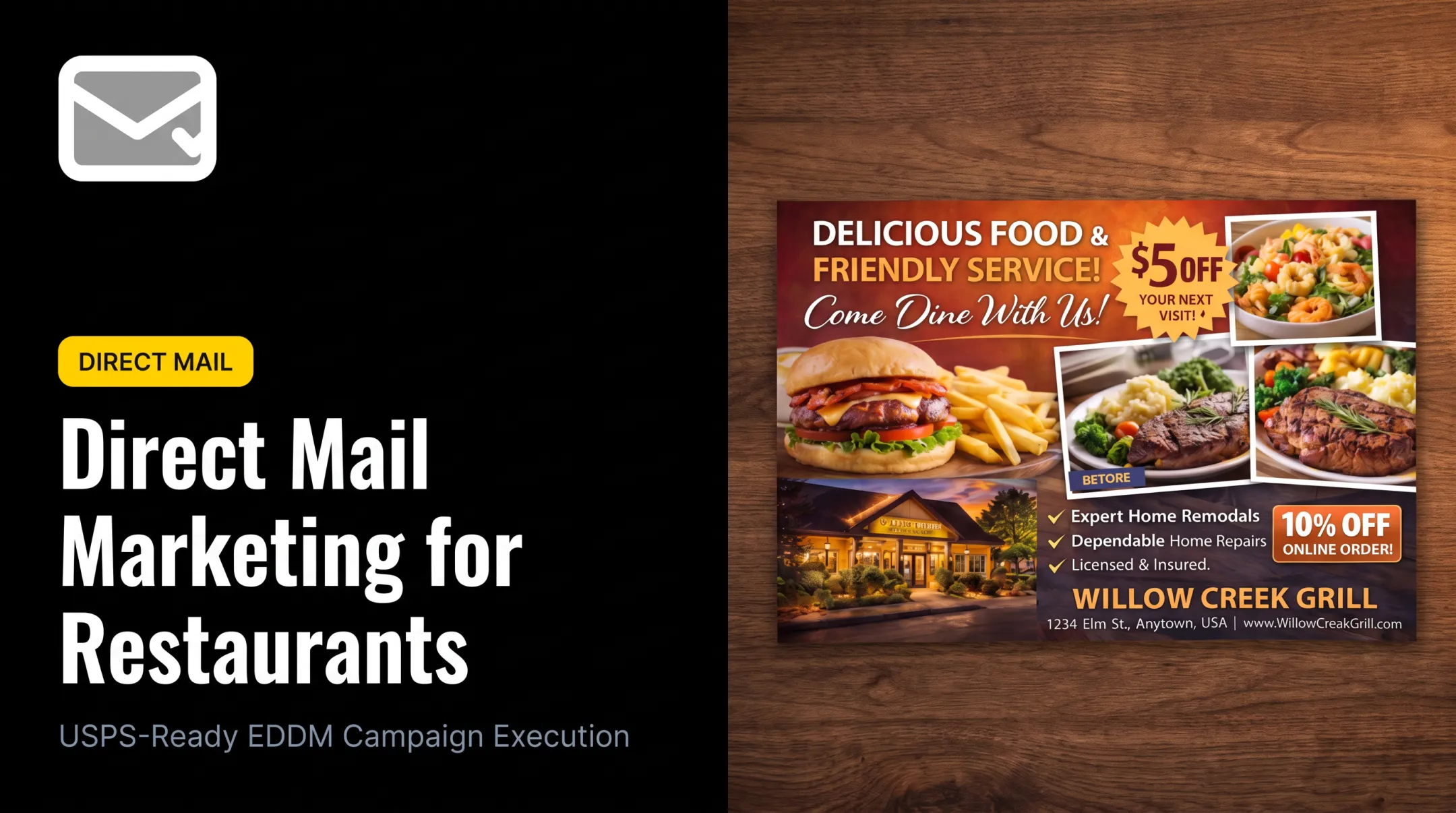
A quick example: Picture a postcard for a fictional spot called "Harbor & Vine." The front shows a plated pasta dish with steam rising, headline: "New Neighbor? Dinner's On Us." Below it: "$10 off your first visit — mention this card." The back carries the address, hours, a QR code linking to reservations, and fine print: expires in 30 days, dine-in only, one per table.

USPS also recommends testing two message or design variants rather than guessing. Change one variable at a time — the offer, the headline, or the neighborhood — so you actually know what moved the needle.
Targeting, Timing, and Measuring a Restaurant Postcard Campaign
Getting the right postcard to the wrong household wastes the mailer. Targeting decides whether the offer lands with people who can actually visit.
EDDM vs. Targeted Lists
| Approach | Best For | What You Need |
|---|---|---|
| EDDM | Neighborhood awareness, grand openings, broad local coverage | No mailing list required — select carrier routes by ZIP code or map |
| Targeted lists | Specific geographic or demographic filters | Accurate address data, filtered by income, homeowner status, radius, or age |
USPS is explicit that EDDM is built for small businesses like restaurants. It reaches every address on a selected route with a simplified "Postal Customer" model, so you do not need a named list.
Targeted mailing lists let you filter by ZIP code, radius, carrier route, income, homeowner status, age, or business type. That is useful when you want offices within a 10-minute walk for a lunch-catering push.
Defining Your Mailing Area
A realistic trade area usually comes down to:
- How far your guests typically drive to reach you
- Delivery radius if you offer delivery or third-party ordering
- Nearby housing density and competing restaurants
- Kitchen capacity during the promotion window
Timing It Right
- Mail grand-opening cards early enough for production, printing, and delivery lead time.
- Align seasonal or event mailers with the real booking or visit window, not weeks too soon.
- Save slow-day promotions for periods when you can actually serve the extra demand.
- Change the offer or creative on repeat drops; the same card twice teaches you little.
Measuring What Matters
Response volume tells you almost nothing on its own. Track redemptions instead:
- A unique coupon code, QR code, or landing page per audience segment
- A dedicated phone prompt or online-ordering URL
- Staff trained to ask "how did you hear about us?" and log it consistently
Then run the numbers: total campaign cost, redemption rate, average order value, and new-versus-returning customer mix. Attribution will not be perfect when mail runs beside word-of-mouth and digital, but a rough estimate still beats guessing.

A partner like DirectMailEasy can help restaurants choose a product and target area, refine artwork, and handle USPS-ready printing and processing so campaign ops do not compete with running the floor.
Restaurant Postcard Mailer Costs and USPS Considerations
There's no single postcard price. A restaurant mailer quote usually breaks into four parts:
- Creative design: new artwork or a refinement of what you already have
- Postcard production: stock, size, color, finish, and quantity
- Postage and targeting: EDDM routes or list costs, plus addressing
- Fulfillment: USPS processing, delivery coordination, and any rush fees
Quantity, dimensions, paper finish, targeting method, and turnaround all move the total.
Finish options such as matte, glossy, or UV coating change both price and production time. At DirectMailEasy, UV coatings add about five days to the production schedule.
USPS Rules Worth Confirming Before You Print
USPS Postal Explorer lays out specific mailing requirements that change how much you'll pay and whether your piece even qualifies:
- Postcard-price dimensions: 5" x 3.5" minimum up to 6" x 4.25" maximum for First-Class postcard pricing; anything larger gets charged as a letter.
- EDDM-Retail saturation rules: each mailing requires at least 200 pieces or 50 pounds, capped at 5,000 pieces per day per 5-digit ZIP Code, entered at the designated post office.
- EDDM indicia placement: the required postage indicia must be printed above and to the right of the simplified address, using the exact wording USPS specifies.
- Address orientation: placing the address parallel to the short edge on a postcard-size piece can make it nonmailable under First-Class rules.
Postage rates and dimension rules change over time, so verify current specs on USPS.com or with your mail provider before you lock a print run.
Request a physical proof and confirm final specs. Partners like DirectMailEasy handle addressing, barcoding, USPS paperwork, and delivery coordination in one workflow, so you can stay focused on the restaurant instead of postal forms.
Frequently Asked Questions
How much do restaurant postcard mailers cost?
Most restaurant mailers are priced per piece. Final cost reflects design, quantity, size and finish, postage class, and EDDM versus a targeted list. Ask for an itemized quote so design, print, and postage stay separate.
How effective are restaurant postcard mailers?
Results show up in redemptions, not pieces mailed. Strong offers, tight local targeting, clear design, and steady timing drive response—track each drop with unique codes or QR links.
What are the USPS rules for restaurant postcard mailers?
Rules cover dimensions, thickness, postage class, addressing, indicia placement, and EDDM saturation requirements. Confirm current specifics on USPS.com or with your mail provider before printing.
What should a restaurant postcard mailer include?
A clear offer, appetizing imagery, restaurant details, a strong call to action, an ordering or booking path, and expiration terms. Add a trackable response method so you know what worked.
Should restaurants use EDDM or a targeted mailing list?
EDDM covers entire neighborhoods without needing an address list, ideal for grand openings or broad awareness. Targeted lists work better when you want specific income, homeowner, or radius filters.
How often should a restaurant send postcard mailers?
Match drops to your budget, guest buying cycle, and kitchen capacity—often monthly or around seasonal offers. Run a schedule you can sustain, read redemption data, and refresh the offer instead of reprinting the same piece forever.