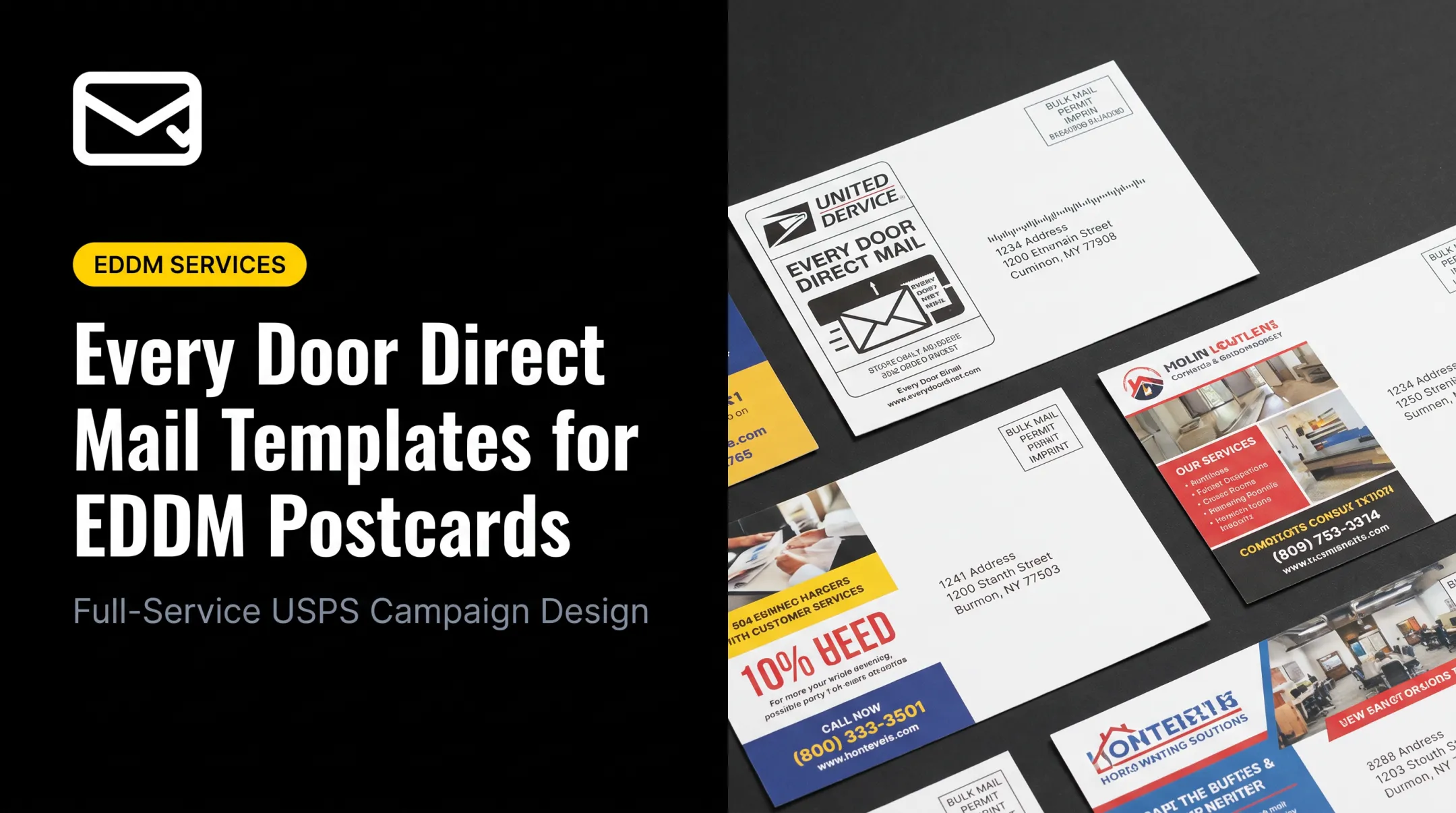

That's the appeal behind EDDM Retail: pick a neighborhood, not a name. But running a successful campaign still means making real decisions — which routes to choose, what mailpiece format works, how to stay USPS-compliant, when to launch, what it'll cost, and whether to handle it yourself or lean on a provider.
USPS rules, prices, dimensions, and delivery windows shift over time, so treat the specifics here as a planning guide. Always confirm exact requirements with current USPS documentation before you print or drop a single piece.
Key Takeaways
- EDDM Retail targets complete carrier routes, ideal for local promotions, openings, and neighborhood lead generation
- Total campaign cost includes design, printing, postage, bundling, and provider fees — not postage alone
- Results hinge on route relevance, a clear offer, a compliant mailpiece, and response tracking
- Compare EDDM Retail against provider-managed EDDM BMEU based on volume, timing, and internal capacity
What Is EDDM Retail and How Does It Work?
EDDM Retail is the USPS Every Door Direct Mail path small businesses use for saturation mail without buying a mailing list. A letter carrier delivers your printed piece to every address on a selected route during normal delivery—no names, no street-by-street list purchase, and no data cleanup.
What you can target:
- Geography: a ZIP code or carrier routes you draw on a map
- Route-level demographics: age range, household size, and income (Census-based indicators)
What you generally cannot target:
- Individual names or specific households within a route
- Narrow, account-based, or one-to-one segments
The Basic Workflow
- Select routes in the USPS EDDM Online Tool, which shows delivery counts and route boundaries
- Design a mailpiece that meets USPS Marketing Mail flat requirements
- Prepare the mailing — bundle by route, complete required paperwork
- Pay postage and submit bundles at the scheduled Post Office
- Wait for delivery as part of the carrier's regular route
Small businesses choose EDDM because it skips traditional bulk-mail setup and puts budget on a defined service area. DirectMailEasy runs this model for local campaigns such as:
- Realtors farming a neighborhood with market updates
- Roofing contractors mailing homes after a hailstorm
- Dental practices promoting new-patient appointments
- Restaurants announcing a grand opening
EDDM isn't the right tool for everything, though. Skip it if your campaign needs:
- Personalized data or named-account targeting
- Confidential or sensitive information
- One-to-one follow-up sequencing
How to Plan and Run an EDDM Retail Campaign
Before touching the route map, write a short campaign brief. Capture at least:
- Objective and primary offer
- Target service area and quantity
- Desired response and how you'll measure success
- Launch date and budget Skipping this step is how route selection and creative decisions end up disconnected from each other.
Choosing Routes
Use the current USPS EDDM tool to compare route boundaries against your actual service area, customer profile, and delivery capacity. A roofing contractor near Eau Claire, for instance, might select routes bordering a recent storm path rather than an entire ZIP code.
Route-level demographics (age, household size, income) are planning inputs, not guarantees. Not every household on a route matches the "average" profile the tool displays.
Building the Mailpiece
A strong EDDM postcard or flat typically includes:
- A prominent headline that states the offer immediately
- One primary offer, not three competing messages
- Recognizable branding and readable contact details
- A clear call to action (call, form, QR, or store visit)
- A response deadline or reason to act now
Production and Submission
- Approve artwork and confirm USPS size, weight, and postage specs
- Print the pieces to the approved stock and finish
- Sort and bundle by carrier route per EDDM rules
- Complete required USPS documentation and postage paperwork
- Submit at the appropriate USPS location for the selected routes
This is where a lot of DIY campaigns stall: bundling and paperwork take real time. DirectMailEasy runs this as one workflow: artwork support, printing, route selection, USPS-ready preparation, and mailing under a single order, and most orders ship within 5–7 business days after proof approval (rush options available).

Build in extra lead time for seasonal, storm-related, or grand-opening campaigns where timing matters. Rushed proof-to-drop timelines are where bundling errors and compliance mistakes creep in.
EDDM Retail Mailpiece and USPS Compliance Checklist
EDDM mailpieces must meet current USPS eligibility rules for format, dimensions, thickness, and weight. Under USPS flat-size rules, a qualifying EDDM flat typically must:
- Exceed 10.5" long, 6.125" high, or 0.25" thick on at least one dimension
- Stay under the maximum flat size
- Weigh no more than 3.3 ounces
Confirm exact thresholds in the latest USPS documentation before you print.
Indicia and Addressing
- Place the indicia above and to the right of the address block, in all caps and at least 4-point type
- Use the approved simplified-address treatment (USPS materials reference "Postal Customer" or "Local Postal Customer")
- Keep contrast high and type legible; avoid busy backgrounds behind small address text
Bundling and Paperwork
EDDM pieces need to be prepared in route-specific bundles with facing slips, plus the required USPS form for EDDM Retail submissions. Confirm current bundle counts and form versions before you head to the Post Office.
Preflight Checklist
Once postal format and paperwork are locked, run a print preflight. Before anything goes to press, check:
- Bleed and safe margins
- Paper stock and fold direction
- Barcodes or QR codes (if used)
- Offer terms, phone number, and URL
- Response or redemption instructions
Common compliance failures:
- Mailpiece too small to qualify as an EDDM flat
- Indicia placed incorrectly or too small
- Mixed routes in one bundle
- Missing required paperwork at drop-off
EDDM Retail drop-off rules are not the same as provider-managed BMEU mailings. Use the Retail checklist above for counter submissions, and treat managed mailings as a separate prep path.
EDDM Retail Costs, Requirements, and Retail vs. BMEU
Postage is only one line item. A realistic campaign budget accounts for:
- Design and artwork
- Printing
- USPS postage
- Route preparation and bundling
- Provider handling fees (if applicable)
- Delivery to the Post Office
- Optional tracking tools
As of the current USPS Notice 123 rate schedule, EDDM Retail postage runs about $0.260 per piece for flats up to 3.3 ounces. DirectMailEasy states that EDDM postage rates are between 24 and 30 cents per piece depending on destination, with EDDM printing starting at $0.19 per piece based on standard quantities. Always confirm current rates before you lock a budget.

To get true cost-per-piece, divide total campaign cost (design + print + postage + prep) by total pieces mailed.
Retail vs. BMEU
| Factor | EDDM Retail | EDDM BMEU |
|---|---|---|
| Typical use | Smaller local campaigns | Larger, recurring, multi-route campaigns |
| Permit needed | No permit required | Bulk mailing permit required |
| Entry point | Scheduled Post Office | Business Mail Entry Unit |
| Volume | 200 to 5,000 pieces per day, per ZIP Code | Higher volume, no volume limit |
| Who preps the mail | Business or provider | Business or provider |
Verify current volume limits and permit rules before committing to either path — USPS updates these periodically.
DIY vs. Provider
Handling EDDM internally gives you control and can feel faster for a single small drop. It also means you own the full workload:
- Staff time for setup and compliance
- Bundling and route prep labor
- Transportation to the Post Office
- Cost of a rejected or reprinted batch
DirectMailEasy provides clear, itemized quotes with printing, postage, design and list costs explained, and handles design, printing, targeting, USPS processing, and mailing in one workflow. That fits businesses that would rather not coordinate five separate vendors.
How to Improve EDDM Results
Better EDDM results come from offer fit, clean tracking, and disciplined tests—not bigger route counts alone. Match the offer to the audience and the moment. A few examples:
- Seasonal HVAC tune-ups timed before the first cold snap
- Post-storm roof inspection offers
- New-patient incentives from a dental or medical practice
- Grand-opening promotions for a new retail location
- Real estate market updates for a farmed neighborhood
Keep the call to action obvious on every piece. Political and election-related mailers also need a compliance check against applicable advertising and election rules before printing.
Measuring Response
Before the drop, record a baseline and set up at least one response path you can attribute:
- A unique promo code
- A dedicated landing page
- A QR code
- A tracked phone number
Add a clear offer end date so you can close the measurement window and tie results to that drop.
Testing and Common Mistakes
Test one variable at a time — headline, offer, format, or timing — while keeping route quality and volume comparable across tests.

Mistakes that sink campaigns:
- Picking routes based on population size alone, ignoring fit
- Sending an unclear or buried offer
- Overloading the design with text
- Skipping a follow-up plan
- Ignoring delivery timing relative to your buying cycle
- Judging results before the buying cycle has played out
Use EDDM Retail when route-based reach and hands-on control fit your operation. When compliance steps, multiple routes, or limited staff time create friction, a full-service partner like DirectMailEasy can run design, print, and USPS prep in one workflow.
Frequently Asked Questions
How much does EDDM cost per piece?
Total cost combines current USPS postage with printing, design, and preparation. Confirm current postage rates and request a full campaign quote before you set the budget.
What are the mailing requirements for EDDM postcards?
Pieces must meet USPS flat dimensions, weight, and indicia placement rules, plus route bundling and required paperwork. Always confirm current USPS specifications before printing.
How long does it take for EDDM to be delivered?
With DirectMailEasy, most orders ship within 5–7 business days after proof approval, separate from USPS delivery once bundles are dropped. Delivery timing then varies by drop-off date, route, and volume.
What is the cheapest way to do EDDM?
Lowest total cost depends on quantity, format, printing choices, and how much staff time you spend on prep. Compare DIY EDDM Retail with provider-managed fulfillment to see which costs less at your volume.
Does Every Door Direct Mail (EDDM) really work?
Results hinge on route relevance, offer strength, clear creative, and timing. Track responses directly instead of assuming every delivered piece drives an immediate sale.
What are common mistakes when using EDDM?
Noncompliant sizing or indicia placement, mixed route bundles, weak calls to action, poor timing, and missing tracking methods are the usual culprits. Always verify current USPS requirements before submission.