
Introduction: Direct Mail Postcard Mailer Designs
A postcard gets only a brief moment in someone's hand before it's read, set aside, or tossed. That brief window has to communicate an offer and point toward one clear action, whether that's a phone call, a booking, a store visit, or a quote request.
Direct mail still earns attention that other channels struggle to match. 84% of consumers read direct mail immediately or the same day they receive it, according to Lob's 2025 State of Direct Mail Consumer Insights Report, up from 70% in 2024.
Small businesses run into the same obstacles over and over:
- Picking the right postcard size
- Balancing eye-catching visuals with copy people can actually read
- Meeting USPS specifications
- Making the response path obvious instead of buried on the back
This guide covers design principles, industry-specific postcard ideas, size and postal requirements, production checks, targeting options, and how to measure results for a U.S. mailing campaign.
Key Takeaways
- Build each postcard around one message, one offer, and one call to action, not five competing ideas.
- Design the front to earn attention and the back to make responding easy.
- Match format, imagery, and targeting to your audience: storm mailers and dental cards need different playbooks.
- Verify USPS rules and printer specs before approving artwork, then test one variable at a time.
Design Principles for Effective Direct Mail Postcard Mailers
Define the objective and audience first
Before opening a design tool, decide the one action the postcard needs to trigger: a phone call, a booking, a quote request, a store visit. Then define exactly who receives it, whether that's a specific neighborhood, a homeowner segment, or a customer type.
Skip this step and you'll end up with a card that looks good but doesn't sell anything specific.
Build a clear visual hierarchy
Every eye should land in the same order: dominant image or headline first, supporting benefit copy second, brand identification third, offer details fourth, and a visually distinct CTA last. Build each layer deliberately:
- A dominant headline or hero image that states the benefit, not just the business name
- A short line of copy that answers "what's in it for me"
- Logo and brand colors placed for recognition, not fighting with the offer for space
- The offer treated as its own visual block, not buried inside paragraph text
- A CTA that's bigger, bolder, or a different color than everything else on the card
Color, contrast, and typography
Use brand-consistent colors, but prioritize contrast over aesthetics alone. Light text on a light background might look elegant on a screen; on a 4x6 card scanned from three feet away, it disappears.
Practical rules:
- Keep body copy large enough to read without reading glasses
- Use photos or illustrations directly relevant to the offer, not generic stock filler
- Limit yourself to two or three type sizes and one accent color
Write copy that leads with the reader's benefit
Open with what the recipient gets, not what the business does. "Save $50 on your next AC tune-up" beats "ABC HVAC has served the area for 20 years."
Skip jargon that needs a translator. Use urgency language, like a real deadline, only when the limitation is genuine — fake urgency erodes trust fast.
The front-and-back relationship
The front's job is simple: earn attention and get the card flipped over. Lead with the main visual, headline, and a short, benefit-driven offer.
The back carries the weight of conversion:
- Supporting details that answer lingering questions
- Business name, phone number, address, and website
- Clear response instructions: call, scan, or visit
- The mailing panel and postal markings, reserved and left uncluttered
A clear offer paired with an obvious next step is what generates the response. Keep the CTA clear of the barcode and address block so nothing competes for that final action.

Direct Mail Postcard Design Ideas for U.S. Small Businesses
Different industries need different postcard playbooks. Six common verticals and how they usually show up in the mail:
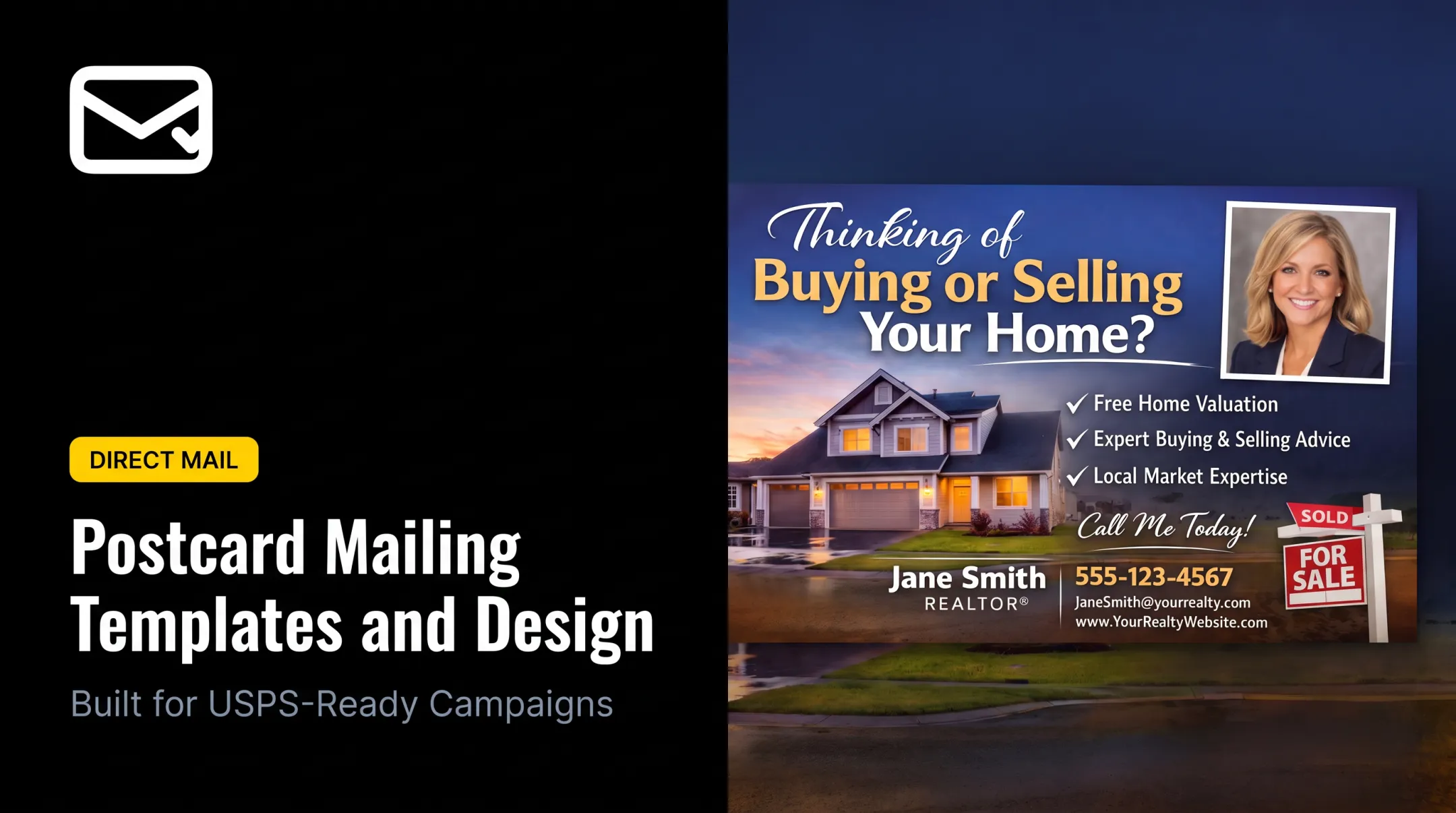
- Real estate: Just-listed, just-sold, market-update, and open-house cards built on property photos plus agent branding. CTA: book a valuation or view a listing—often a 6x9 with a home photo, headshot, and free-valuation offer for neighborhood farming.
- Roofing and exterior contractors: Storm-response and seasonal inspection mailers with before-and-after photos, service-area lines, and proof such as licensing or local reviews. CTA: request a free inspection or estimate (storm repair is a staple campaign).
- HVAC, plumbing, and electrical: Seasonal maintenance reminders, first-time discounts, or service checklists. CTA: book online or call, with a real expiration date on the offer when one applies.
- Dental, medical, and wellness: New-patient designs that build trust with friendly imagery, plain-language benefits, office hours, and insurance acceptance. CTA: a simple, compliant way to book a first visit.
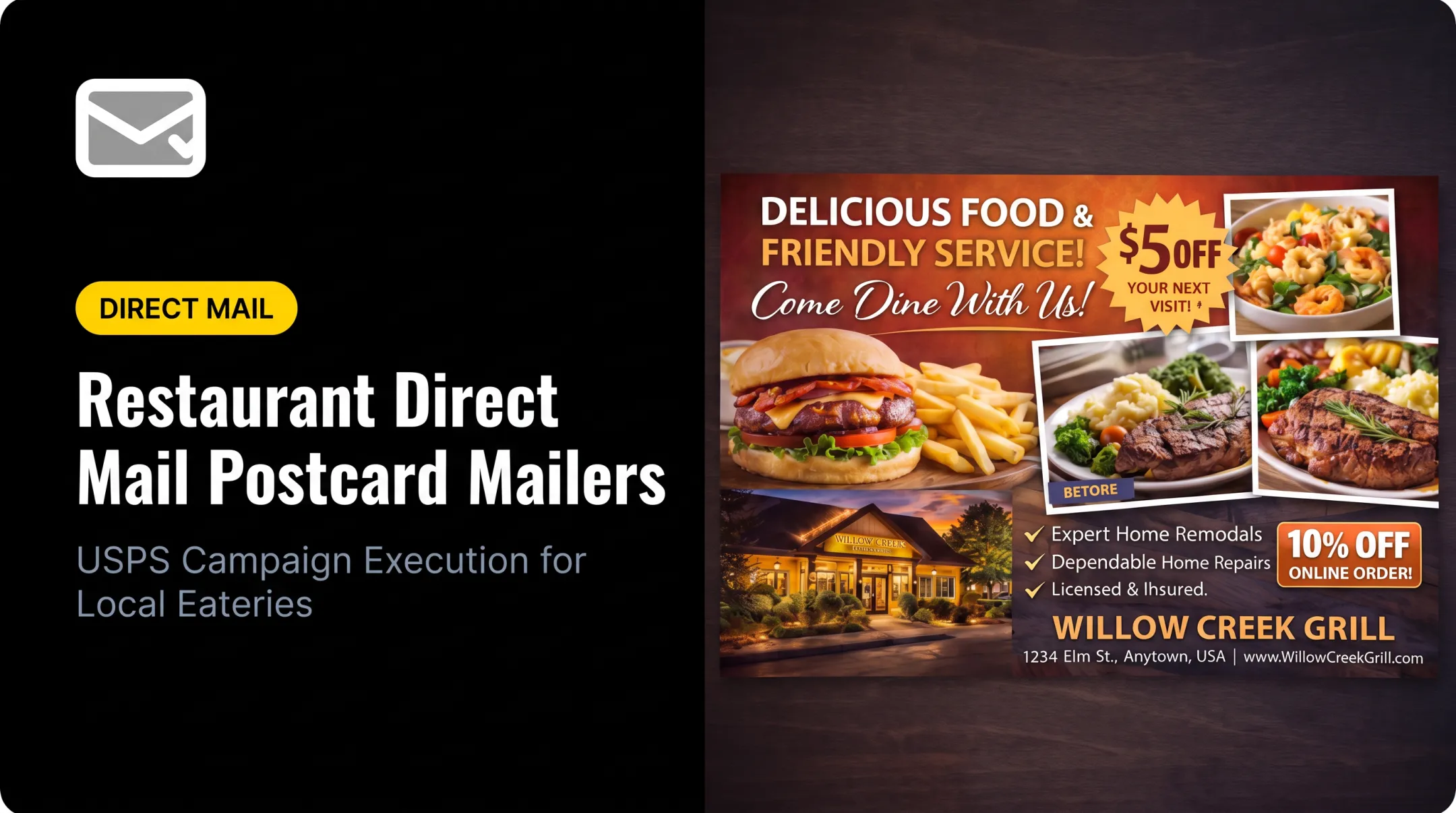
- Restaurants, retail, and new locations: Grand-opening, limited-time, or neighborhood welcome cards. A "Now Open" layout with a $1-off drink or giveaway works well with a QR code plus a non-digital redemption path.
- Insurance and political campaigns: Quote-request mailers with a callback number, or voter pieces with clear branding and required disclosures. One next step, stated once.
Personalize without losing consistency
Vary the headline, offer, image, or proof point by neighborhood, customer type, or campaign stage, but keep layout, logo placement, and brand colors identical across versions. That consistency is what makes repeat mailings recognizable.
A mini creative brief before you design
Answer these before opening a design file:
- Who's the audience?
- What problem or need does the offer solve?
- What's the offer, and what's the proof behind it?
- What's the primary CTA, and is there a backup response method?
- What's the delivery area and deadline?
- How will you measure success?
Trust matters as much as visuals
Use legible text, plain language, accurate business details, and offers you can actually back up. If the offer or claims can't hold up after the phone rings, the design worked against you.
Postcard Size, USPS Rules, and Production-Ready Artwork
There's no single "correct" postcard size. The right one depends on your goal, budget, and mail class. Compact cards cost less to print and mail; oversized pieces stand out more but cost more and may shift into a different postage category.
Common U.S. postcard format ranges (verify current specs before printing):
| Format | Typical dimensions | Best for |
|---|---|---|
| Compact | 4" x 6" | Quick offers, contractor specials, insurance quotes |
| Standard | 5" x 7" or 6" x 9" | Restaurant menus, real estate, home services |
| Oversized | 6" x 11" | Grand openings, event announcements |

USPS First-Class postcards have their own size and thickness rules: rectangular, roughly 3½" to 4¼" high, 5" to 6" long, and 0.007" to 0.016" thick.
A piece outside those limits is charged at letter rates instead. Catch that before a large print run.
Addressing, EDDM, and mail class
Two mailing methods handle addressing very differently:
- Individually addressed mail requires a mailing list and a reserved addressing/postage area with correct barcode placement.
- Every Door Direct Mail (EDDM) reaches every address on a selected route using simplified "Postal Customer" addressing and a specific USPS indicia, with no mailing list and no special mailing permit required for EDDM Retail.
EDDM also has its own format rules, minimum quantities (typically 200 pieces), and per-ZIP-code daily limits that differ from individually addressed mailings.
Preparing print-ready files
Before sending artwork to a printer:
- Set trim size, bleed, and safe area; keep text and logos off the edges
- Use the required color mode, 300 DPI minimum, and PDF when possible
- Test every QR code, URL, phone number, and promo code before print
Preflight checklist:
- Spelling, business name, and contact details
- Offer terms, expiration date, and required disclosures
- Address accuracy, postal indicia placement, and barcode clear zone
- Image rights and a signed-off final proof
DirectMailEasy lets you upload your own artwork, and its design team can create files from scratch or refine existing artwork. Confirm current USPS size, postage, and EDDM rules before you commit to a large run.
Plan, Produce, and Measure the Campaign
A postcard design is only half the campaign. The rest is choosing who receives it, how it gets mailed, and how you'll know it worked.
The workflow, start to finish
- Choose a mailing list or EDDM route based on your target area
- Set quantity and budget
- Write the offer and design the card
- Approve a print proof
- Print, prepare for USPS processing, and mail
- Monitor responses and follow up

DirectMailEasy runs a simplified version of this on its end: choose your product, design and approve it, then let the print-and-mail phase, including addressing and USPS processing, take over. That leaves you free to manage the offer and the follow-up.
How targeting shapes design and cost
- EDDM routes — Reach every household on selected carrier routes without a mailing list; ideal for neighborhood-wide contractor or restaurant campaigns
- ZIP or radius targeting — Narrow delivery to a specific area around your business
- Demographic filters — Match the offer by income, homeowner status, or age
- Business and industry lists — Fit B2B mailers and industry-specific outreach
Reaching every address in an area through EDDM is a different targeting decision than mailing to named recipients on a list. It affects addressing, the design itself (the "Postal Customer" line, for instance), and postage.
Tracking what actually happened
A postcard without a way to measure response is a guess dressed up as a campaign. Common tracking methods include:
- Unique landing pages or vanity URLs
- QR codes tied to a specific offer
- Dedicated phone numbers or campaign-specific promo codes
- Booking links or reply cards
- Simply asking new customers how they heard about you
Tracking has shifted heavily toward digital methods. In the ANA Response Rate Report 2023, 82% of respondents who tracked direct-mail response used online tracking such as QR codes or specific URLs, up from 67% in the previous study.
Metrics worth calculating:
- Delivery volume
- Inquiries generated
- Appointments booked
- Conversions and revenue
- Cost per response
Change one variable at a time between mailings—the offer, the image, or the CTA—so you know what actually moved the needle.
Conclusion: Turn a Postcard Design Into a Complete Campaign
A strong postcard design is only one piece of the campaign. Effective direct mail also needs:
- A focused offer matched to the right audience
- Readable layout and USPS-compliant specs
- A frictionless response path
- A follow-up plan once calls and replies start coming in
Start with one clearly defined audience and one campaign objective. Build a production-ready proof, verify current USPS requirements, and put a way to measure results in place before the cards ever leave the printer.
From there, you can expand or adjust the campaign based on real response data. DirectMailEasy handles design, printing, targeting, and USPS-ready mailing in one workflow, so you can stay focused on the offer and on the leads that come back.
Frequently Asked Questions
What is the standard size of a postcard mailer?
There isn't one universal size. Common U.S. formats run from compact 4x6 cards to oversized 6x11 pieces—confirm current USPS and printer specs before you lock design or postage.
What are USPS rules for postcards?
USPS sets specific dimension, thickness, mail-class, addressing, barcode, and placement requirements that vary by postcard category and mailing method. These rules change periodically, so check current USPS guidance or ask your mailing provider before printing.
How much does it cost to advertise through direct mail?
Total cost depends on design, paper and finish, quantity, printing, list or route targeting, addressing, postage, and preparation. Request an itemized quote for your postcard size and mailing volume.
What are some creative direct mail ideas?
Strong options include seasonal service offers, real estate neighborhood farming, storm-response inspections, grand-opening mailers, new-patient campaigns, and QR-enabled reply cards. Match the concept to your audience and one clear call to action.