
The problem is most landscaping mailers fail before they're even printed. Many businesses mail an entire ZIP code with no clear offer, send postcards during the wrong season, bury the call to action, or generate a stack of calls that never turn into profitable jobs. This guide covers what direct mail actually is, how to target it using EDDM or mailing lists, how to build a campaign around neighborhoods and seasons, what belongs on the mailer itself, and how to track results that matter.
Key Takeaways
- Audience, offer, delivery area, and timing should be planned together, not chosen separately.
- Existing customers and profitable service areas point to the best neighborhoods for new jobs.
- EDDM covers neighborhoods without a list; targeted lists narrow the audience by household data.
- One service, one offer, one call to action, then measure calls, quotes, and booked revenue.
Why Direct Mail Can Work for Landscaping Businesses
A postcard sitting on a kitchen counter works differently than a digital ad. It doesn't disappear when someone closes a tab. According to USPS, advertising mailers stay in U.S. households for an average of 17 days, giving a homeowner time to notice a lawn care offer right when their yard needs attention. That staying power complements search ads, social posts, and email; it does not replace them.
Direct mail also has a route benefit that digital channels can't touch. Winning three or four new mowing accounts on the same street as current customers means:
- Less drive time between stops
- Easier scheduling for crew leads
- Higher margins on small residential jobs that otherwise barely cover travel costs
That's the real math behind neighborhood-focused mailing: lead location matters as much as lead volume.
Set expectations honestly. Response rates vary by audience quality, season, weather, offer strength, creative, delivery timing, and how fast someone follows up.
Industry-wide, the ANA's 2023 Response Rate Report found house-file response rates around 15.6% and prospect-file rates around 10.8%. The report notes these figures rely on small samples and self-reported estimates, so treat any published benchmark as a reference point, not a promise.

How to Plan and Target a Lawn Care Direct Mail Campaign
Define the business objective before selecting a list
"Get more customers" isn't a targeting strategy. Before picking an audience, decide what the campaign is actually for:
- Acquiring recurring mowing or maintenance customers
- Filling gaps in an existing route's capacity
- Promoting fertilization or weed control programs
- Selling landscape design and installation projects
- Generating spring cleanup or fall cleanup estimates
- Reactivating past customers who haven't rebooked
The objective drives everything downstream: which households you mail, what the offer says, which mail format you use, where the response lands, and what number counts as success.
Start with profitable neighborhoods and existing customer patterns
Map your current customers, recent estimates, and completed jobs. Look for clusters where property types match your ideal job, demand already exists, and there's room to add density to a route you're already running.
Prioritize households near current routes over mailing an entire city. Here's the difference in practice:
- Concentrated campaign: Mail 500 households within a half-mile of 20 existing customers. New jobs slot directly into an existing route with minimal added drive time.
- Scattered campaign: Mail 500 households spread across an entire metro area. Even with a strong response, new jobs are isolated, and crews spend more time driving than working.

The concentrated approach keeps new stops on routes you already run, so crews spend more time working and less time driving.
Choose between EDDM and targeted mailing lists
Every Door Direct Mail (EDDM) reaches every address on selected USPS carrier routes without needing individual names or addresses. It's built for neighborhood-wide awareness, seasonal offers, and route-building — the USPS EDDM tool lets you search by address, city or ZIP Code and select multiple routes. With DirectMailEasy's EDDM service, you can select routes by ZIP code or draw them on a map, and the mailer reaches every home on them.
Before you launch, lock in these EDDM basics:
- EDDM has a 200-piece minimum per campaign
- At DirectMailEasy, EDDM postage runs between 24 and 30 cents per piece, depending on destination
- USPS paperwork and required indicia need to be prepared correctly to avoid delays
Targeted mailing lists narrow the audience using filters like ZIP code, radius, carrier route, homeowner status, age, or income, where legally permitted. This suits businesses that want to exclude renters, focus on higher-income neighborhoods, or reach a specific age bracket for services like landscape design. Available filters, list quality, and minimum quantities vary by provider, so confirm those details before committing a budget.
Match the audience to the service and desired customer
A $59/month mowing offer and a $15,000 landscape installation don't belong to the same audience or the same message. Define who you're actually trying to reach:
- Service radius your crews can profitably cover
- Property type (single-family, size, lot characteristics)
- Minimum project size for design/build offers
- Neighborhoods you can't service well, even if geographically close
Excluding the wrong households upfront saves money and prevents quotes that never convert.
Build a seasonal campaign calendar
Timing needs to hit before the customer's decision window, with enough runway for inquiries, estimates, and scheduling. NALP notes that spring cleanup start dates vary significantly by location and depend on staffing, weather, and regional climate — there's no single national mailing date that works everywhere.
Build your calendar around what's actually happening in your market:
- Spring cleanup and lawn treatment startup
- Mowing season kickoff
- Irrigation startup
- Landscape installation windows
- Fall cleanup and leaf removal
- Snow services or holiday lighting, where relevant
Base drop dates on your local frost dates, peak mowing weeks, and when competitors start booking—not a generic national calendar.
What to Put on Your Mailer
Make the value proposition immediately clear
Skip "full-service landscaping." Lead with the outcome the homeowner actually wants. State the service area and give a reason to act now, in language that takes two seconds to understand:
- A healthier lawn
- A cleaner yard before guests arrive
- A low-maintenance landscape
- A property that's ready for spring
Use one focused offer and one primary call to action
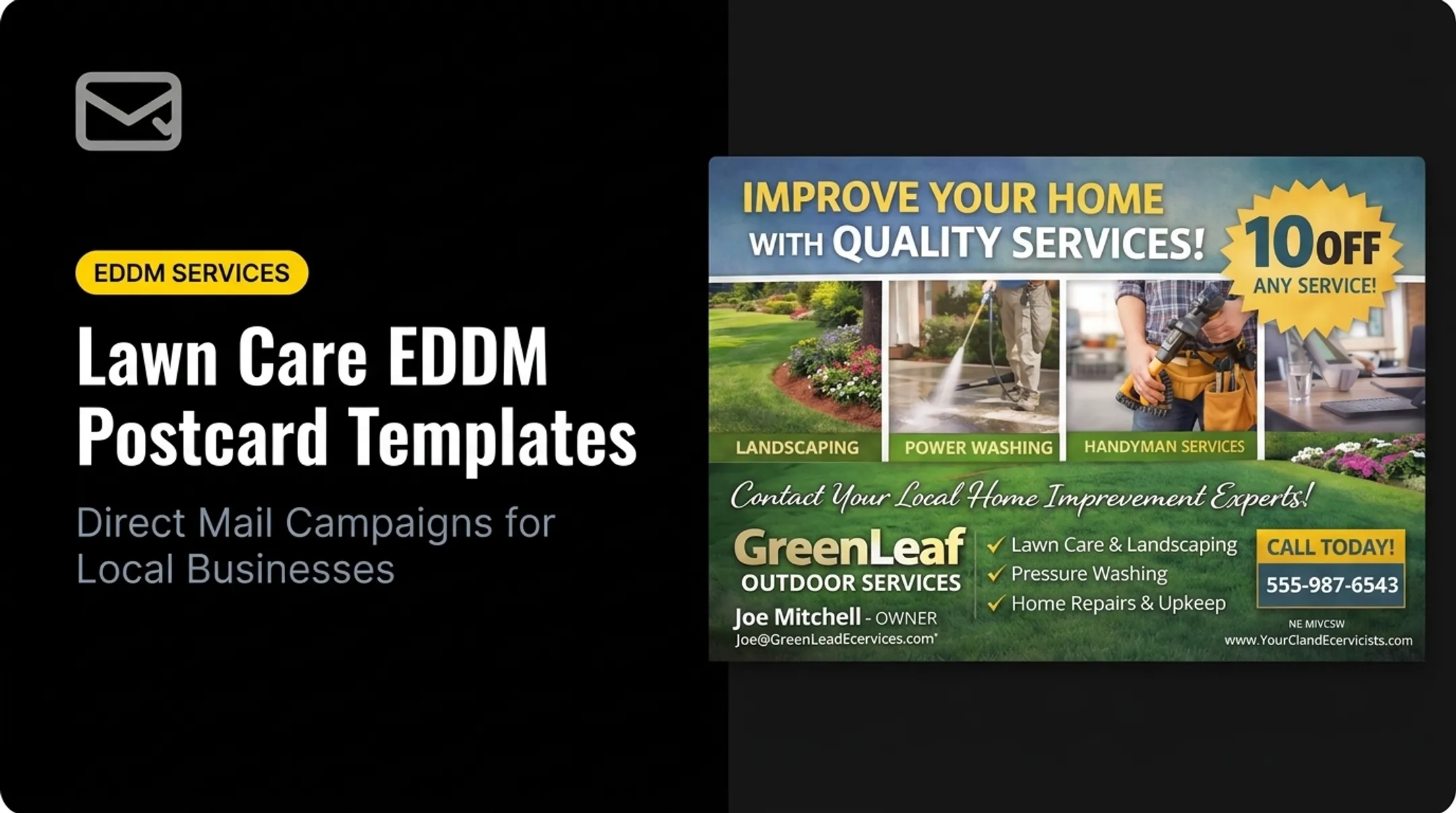
Promoting five services with three different offers dilutes attention and confuses the next step. A strong home services postcard makes the point: it promotes a single, clear offer, such as $10 off any service, alongside a focused list of related work like lawns, gardens, and outdoor cleanup.
Pick one call to action per mailer:
- Request a quote
- Book an estimate
- Scan a QR code
- Visit a campaign landing page
- Call a tracked phone number
Match the CTA to the offer: a recurring mowing deal often works best with a tracked phone call, while landscape design usually converts better on a portfolio or quote page.

Use visuals, proof, and concise copy
Before-and-after photos work especially well for lawn and landscaping services because the transformation is visible. Pair strong imagery with:
- Recognizable branding
- Service-specific benefits, not generic claims
- Testimonials, review excerpts, or licensing/insurance details — only when you can back them up
- Clear visual hierarchy: headline, offer, then contact method
Keep copy short. Homeowners scan mail for a few seconds before deciding whether to keep it.
Personalize where it improves relevance
A recipient's name or neighborhood reference can boost relevance. Bad personalization backfires fast: a misspelled name or wrong neighborhood reads as sloppy, not thoughtful.
Verify address data and suppression lists before printing, and check privacy requirements for every field you use.
Design for response and mobile follow-through
A QR code or short campaign URL should send readers to a quote form, portfolio, or booking calendar. Test every link on a real phone before you mail.
Give the campaign its own tracked phone number, extension, or promo code so you can tell which responses came from that mailer, not your website's general contact form.
Choose the Right Direct Mail Format
Format affects how much you can say, how it feels to open, and what it costs. Here's how the main options stack up:
| Format | Best For | Notes |
|---|---|---|
| Postcard | Fast offers, visual before/afters, single CTA | No envelope to open; lower postage than letters |
| Self-mailer | Slightly more content without an envelope | Folded format; USPS sets minimum paper-weight and sealing rules |
| Brochure | Multi-step services, project options, financing details | More room for detail; higher production cost |
| Letter | Personal tone, higher-ticket offers | Requires an envelope; can feel more formal |
| Flyer/flat | Larger visuals, EDDM route mailings | More room, but weight affects postage |
Postcards tend to work well for recurring mowing offers and quick seasonal promotions since the message is simple and visual. Brochures or letters make more sense when a prospect needs to understand multiple service tiers or a landscape financing option.
Production choices matter too. DirectMailEasy's postcard printing starts at $0.13 per piece based on standard quantities, with paper stock options including matte, glossy, and UV coated.

Final cost depends on size, finish, quantity, and postage. Decide the objective and budget first, then pick the format that fits.
How to Launch, Track, and Improve the Campaign
Prepare production, mailing, and compliance details
Before anything goes to print, run through a preflight checklist:
- Confirm final artwork, contact details, and service area are accurate
- Verify the offer terms and expiration date are printed clearly
- Test the QR code, URL, and phone number
- Double-check address accuracy and USPS preparation requirements
- Confirm postage class and quantity match the campaign budget
- Make sure staff know when responses will start coming in DirectMailEasy's process follows three steps: choose your product, approve the design, then print and mail. The company handles artwork refinement, commercial printing, EDDM route or list selection, USPS paperwork, and delivery to postal facilities. That one-vendor path is a practical option for a small landscaping business that doesn't want to coordinate five suppliers for a single mailer.
Establish tracking before the first piece is mailed
Every channel on the mailer needs its own identifier: a dedicated phone number, a unique QR code, a short URL, or a promo code. Log every inquiry into a CRM or even a simple spreadsheet, tracking:
- Estimate requests and booked jobs
- Average job value
- Service type and neighborhood
- Repeat business over time Separate direct responses (someone calls the tracked number) from assisted conversions (someone sees the mailer, then searches your name and calls your main line). Direct responses show immediate mail lift; assisted conversions show brand recall.
Follow up quickly and professionally
A mailer that generates calls is wasted if those calls go unanswered. Build a simple response process:
- Answer and return calls quickly
- Respond to web forms the same day
- Always ask how the prospect heard about you Follow-up shouldn't stop at the first touch. A second mail piece, an email to your existing list, or a quick social post can reinforce the offer for people who didn't respond right away.
Test one meaningful variable at a time
Change one thing between campaigns: the audience segment, the offer, the headline, the image, or the call to action. Changing everything at once makes it impossible to know what actually moved the needle. Compare results over consistent time periods, and don't draw conclusions from a handful of responses — small sample sizes lie.

Evaluate profitability, not just response volume
A stack of calls means nothing if the jobs don't pay. Build a simple framework:
- Total campaign cost (printing, postage, design, list or EDDM fees)
- Number of qualified inquiries and estimates
- Booked jobs and total revenue
- Gross margin per job
- Customer acquisition cost
- Expected repeat value over the season A campaign can pull plenty of low-value responses and still lose money. Use these numbers to scale what works, revise weak offers, pause underperformers, or move budget to a better neighborhood.
Conclusion
Landscaping direct mail that works is an operating decision. Audience, neighborhood, season, offer, format, and crew capacity all need to line up before a single piece goes to the printer.
Start small and treat the first drop as a test:
- Pick one service and one priority neighborhood
- Lead with one trackable offer
- Measure from the first call through the booked job
- Use that data to sharpen the next mailing
If coordinating design, targeting, printing, and USPS processing is more than you want to manage in-house, DirectMailEasy can handle that workflow end to end. The strategy above works either way, regardless of who prints your mailer.
Frequently Asked Questions
What does "direct mail" mean?
Direct mail is printed marketing sent through the postal system to selected households or businesses. It includes postcards, letters, brochures, self-mailers, and EDDM pieces.
Is direct mail effective for lawn care and landscaping companies?
Effectiveness depends on targeting, timing, offer quality, creative, follow-up speed, and tracking — not the channel alone. A well-targeted mailer with a weak follow-up process will underperform regardless of design.
What should a lawn care company put on a direct mail postcard?
Include one relevant service, a clear benefit, strong visual proof like before-and-after photos, your service area, a reason to act now, and one primary call to action such as "Request a Quote."
Should landscaping companies use EDDM or a targeted mailing list?
EDDM works well for reaching every home on selected carrier routes without needing individual addresses, ideal for neighborhood-wide awareness. Targeted lists make more sense when specific household filters like homeowner status or income matter to your offer.
How often should a landscaping company send direct mail?
Cadence should reflect local seasonality, the service being promoted, budget, and your team's capacity to follow up on responses. Validate timing against demand in your specific market rather than a fixed national schedule.
How can a lawn care business track direct mail results?
Use a unique phone number, QR code, landing page, or promo code for each campaign, and ask every new lead how they heard about you. Track results from initial inquiry through booked job and repeat business, not just call volume.