
Many small-business owners freeze at this stage. What do I say? How much should I include? Who actually gets this thing in the mail? And can a paper card really compete with email and social ads?
This guide walks through postcard samples by business goal and industry, then covers design, targeting, budget, and how to turn a sample into an actual campaign.
Key Takeaways
- Build each postcard around one objective: inbound calls, grand openings, win-backs, or booked appointments.
- Match your offer, audience, visual, and CTA—don’t cram in unrelated details.
- Pick EDDM for neighborhood saturation or a targeted list for specific customer traits.
- Track every mailing with a landing page, QR code, promo code, or dedicated phone number.
Why Use Postcard Marketing?
Postcards give you something digital ads can't: a physical object that sits on a kitchen counter for days. It works alongside email, social, and search rather than replacing them. A prospect who ignores your Facebook ad might still glance at a card while sorting mail.
Postcards support a wide range of business goals:
- Local brand awareness in a defined service area
- Lead generation and appointment booking
- Grand-opening and event promotion
- Customer reactivation and referral requests
- Seasonal offers tied to weather or holidays
What the Data Actually Shows
The ANA's 2023 Response Rate Report found clear gaps between list types:
- House lists (existing customers): 15.6% response rate and 160.9% ROI
- Prospect lists: 10.8% response and 33.7% ROI

These are direct-mail benchmarks reported by the Association of National Advertisers. They come from member-submitted campaign data across formats, not postcard-only results, and sample sizes were small.
Treat the numbers as directional evidence that mailing existing customers tends to outperform cold prospect lists, not a guarantee for your next campaign.
Postcards work especially well for businesses tied to a physical area:
- Home-service contractors with a defined service radius
- Medical and dental practices drawing from nearby ZIP codes
- Real estate agents farming specific neighborhoods
- Restaurants and retailers with a local trade area
Choose the Right Postcard Sample for Your Goal
Different objectives call for different postcard formats. A promotional offer card behaves nothing like an appointment reminder, and a grand-opening announcement needs different real estate than a customer win-back piece.
Common formats include:
- Promotional offer cards — discount or deal, expiration date, clear redemption steps
- Service-area introduction cards — "we're now serving your neighborhood"
- Appointment reminders — date, time, location, one confirmation action
- Grand-opening cards — announcement, address, hours, opening incentive
- Neighborhood-farming cards — recurring real estate touchpoints
- Thank-you and referral cards — post-purchase relationship building
- Win-back cards — reactivation offer for lapsed customers
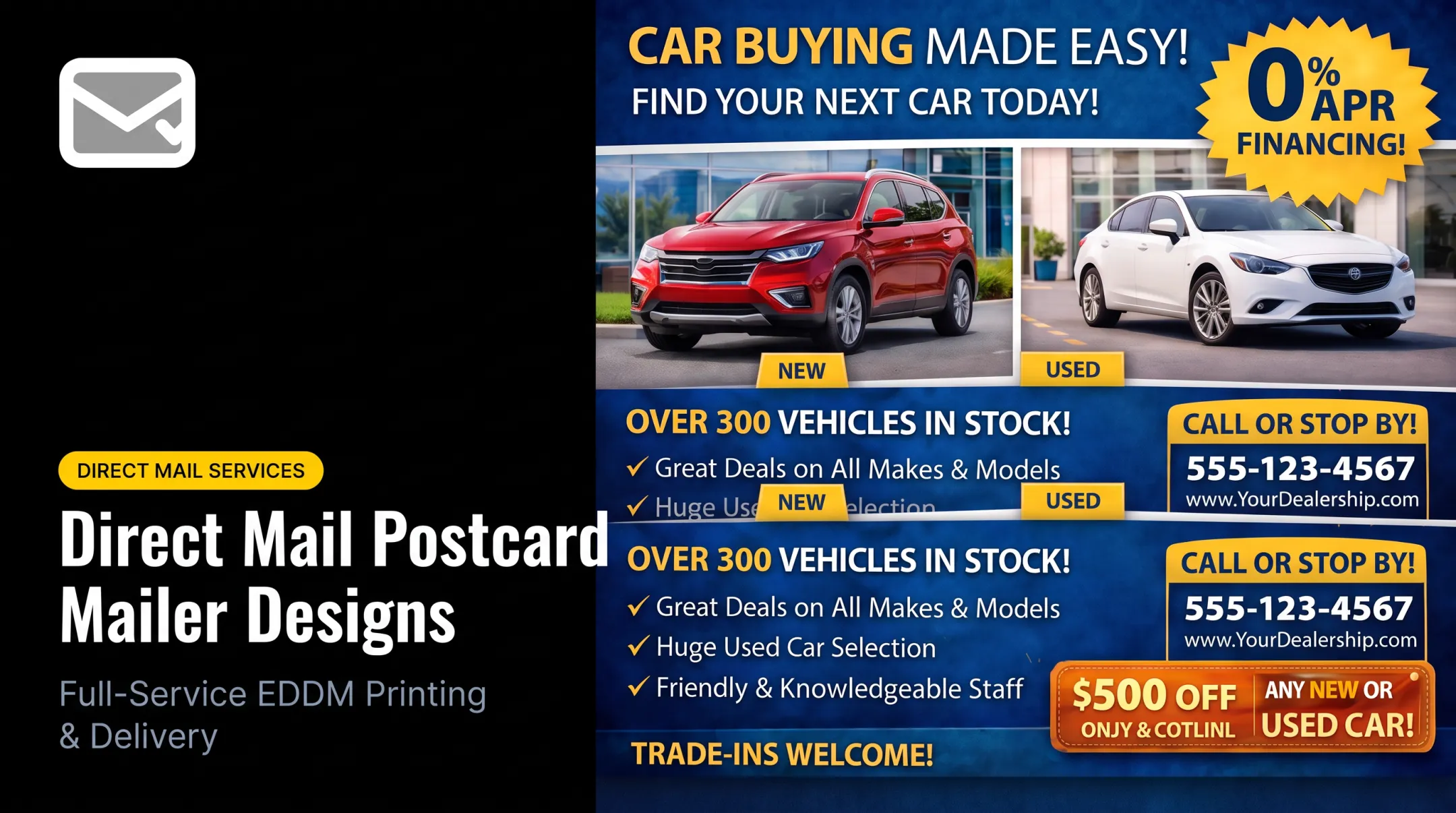
A simple self-mailing postcard usually beats an elaborate folded piece when your budget is tight, your message fits in a few lines, and you need a fast response. Save multi-panel formats for offers that genuinely require more explanation, like a detailed service menu or financing terms.
Format is only half the decision. How you reach the mailbox—saturation routes or a named list—should shape which sample you pick.
EDDM vs. Targeted Mailing Lists
| Factor | EDDM | Targeted List |
|---|---|---|
| Requires a customer list | No | Yes |
| Targeting method | Carrier routes, filtered by age, household size, income | Named addresses, ZIP, radius, homeowner status, business type |
| Minimum quantity | 200 pieces per USPS rules | Varies by list size |
| Best for | Neighborhood saturation, grand openings | Repeat customers, specific demographics |
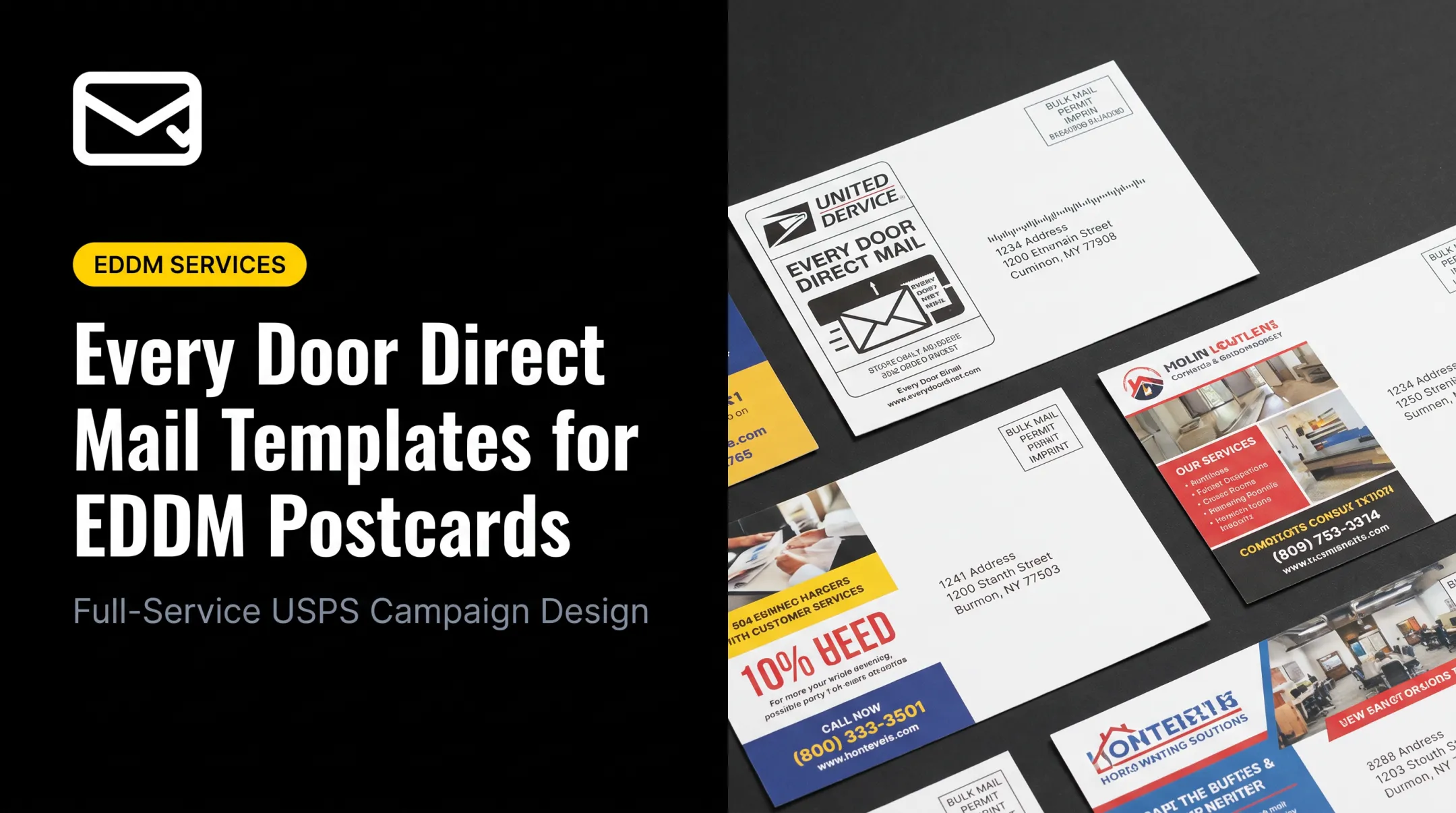
USPS Every Door Direct Mail lets you select routes through an online map tool and delivers to every address on that route with a simplified "Postal Customer" label—no mailing list needed.
DirectMailEasy handles EDDM route selection for local businesses with a 200-piece minimum. When you need a tighter audience, it also supports targeted lists filtered by ZIP code, radius, carrier route, income, homeowner status, age, and business or industry type.
Before you pick a sample, lock in:
- Goal
- Audience
- Geographic area
- Offer
- Quantity
- Timing
- Response tracking method
That framework picks your format faster than scrolling templates.
Direct Mail Postcard Marketing Samples
Each sample below is a starting model, not a template to copy word-for-word. Adapt the offer, imagery, and specifics to your business. Every sample follows the same structure: objective, front concept, back content, CTA, targeting method, and tracking idea.
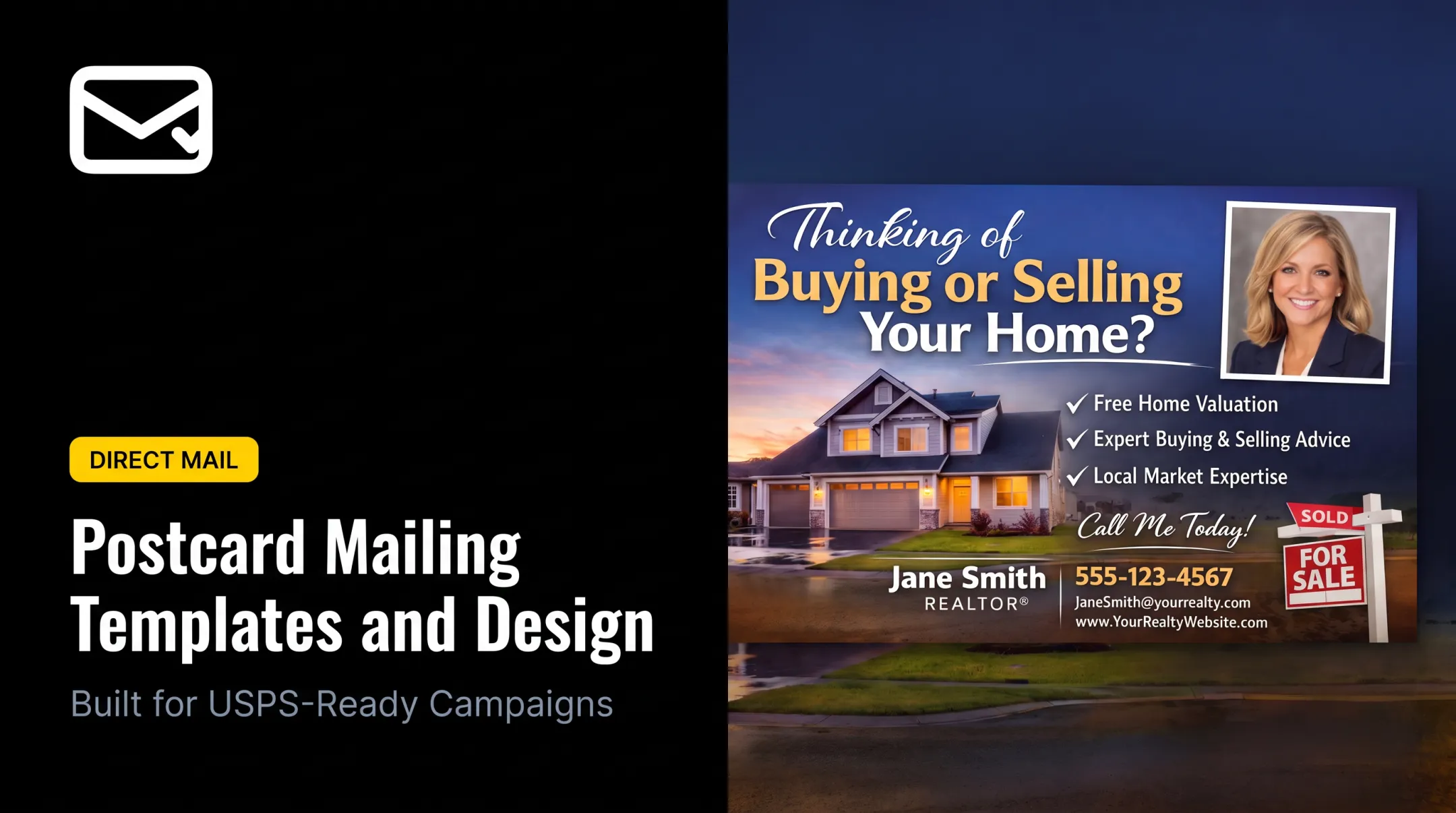
Real Estate Postcard Sample
Objective: Generate seller leads and reinforce agent presence in a farm neighborhood.
- Front: A recognizable local home image with a "Just Listed" or "Just Sold" banner and agent branding
- Back: Free home valuation offer, local market expertise, buying/selling advice, agent contact block
- CTA: "Call for your free home valuation"
- Targeting: Carrier-route farming or a homeowner list within a specific ZIP radius
- Tracking: Dedicated phone line or a QR code to a valuation landing page
A 6 x 9 format leaves space for a local home photo, agent branding and local market messaging. Leave room for property details, license disclosures required in your state, and complete contact information.
Regulators like the California DRE require license numbers on any card soliciting a professional relationship (California Business and Professions Code § 10140.6).
Roofing or Storm-Restoration Postcard Sample
Objective: Drive inspection calls after a storm or during peak roofing season.
- Front: A trustworthy contractor image with a seasonal inspection or storm-check message
- Back: Service-area statement, licensing proof, one clear offer (such as a free inspection)
- CTA: "Schedule your free roof inspection"
- Targeting: Route selection focused on storm-affected neighborhoods
- Tracking: Unique phone number tied to the mailing
Avoid fear-based language or unverifiable damage claims. State insurance regulators, such as the Pennsylvania Insurance Department, warn homeowners about contractors who use high-pressure tactics after storms. Stick to a factual, low-pressure inspection offer.
HVAC, Plumbing, or Electrical Postcard Sample
Objective: Book seasonal maintenance appointments or promote a limited service offer.
- Front: One prominent benefit ("Beat the summer rush — AC tune-up special")
- Back: Service-area detail, clearly stated offer terms, booking instructions
- CTA: "Book your tune-up today"
- Targeting: Homeowner list within your service radius
- Tracking: Dedicated phone number, QR code, or landing page
A 6 x 9 postcard gives this kind of seasonal offer room to breathe. A dedicated tracking number lets you attribute booked calls directly to the mailing rather than guessing where leads came from.
Dental, Medical, or Wellness Postcard Sample
Objective: Attract new patients, especially new movers to the area.
- Front: Welcoming, non-clinical imagery and a simple "New patients welcome" message
- Back: Services offered, insurance accepted, office location, appointment instructions
- CTA: "Call to schedule your first visit"
- Targeting: New-mover lists or a radius around the practice
- Tracking: Office phone line reserved for the campaign
Keep claims accurate and avoid implying any personal knowledge of the recipient's health.
HHS guidance treats promotional healthcare communications as marketing that generally requires patient authorization when it uses protected health information. A general-audience new-mover mailing is different from targeting your existing patient list, so confirm compliance before using patient data.
Insurance Postcard Sample
Objective: Prompt a quote review or coverage checkup conversation.
- Front: "Request a free quote today" with a friendly, local-agent tone
- Back: Auto, home, life, and business coverage options, agent credentials, simple response path
- CTA: "Call for a free quote"
- Targeting: Location-based list or renewal-date targeting
- Tracking: Dedicated agent phone number
A 4 x 6 postcard is usually enough for this format. Frame the offer as a consultation rather than a guaranteed savings promise, and check your state's insurance advertising rules before you mail.
Restaurant, Retailer, or Grand-Opening Postcard Sample
Objective: Drive foot traffic for a new location or seasonal promotion.
- Front: One hero image (the storefront, a signature dish), "Now Open" or seasonal news
- Back: Clear offer with expiration date, address, hours, map or QR code
- CTA: "Redeem this card in-store by [date]"
- Targeting: EDDM saturation of the surrounding trade area
- Tracking: Unique promo code printed on the card
A coffee shop's grand-opening card might follow this structure: a $1-off-drink offer, "Grand Opening" and "Now Open" messaging, and photos of the shop, a latte, and a pastry. A printed promo code makes it easy to separate postcard-driven visits from walk-in traffic.
Political Campaign Postcard Sample
Objective: Reach voters in a specific district or precinct with a clear call to action.
- Front: Candidate photo, election date, district identification
- Back: Key message, voting information, required disclaimer
- CTA: "Vote [date]" or "Learn more at [website]"
- Targeting: Precinct-level EDDM or a voter list filtered by district
- Tracking: Campaign website URL or QR code
Federal Election Commission rules require a clear, conspicuous disclaimer on political mail, including who paid for it and whether it was authorized by a candidate. FEC disclaimer requirements specify formatting details like a boxed disclaimer with adequate color contrast.
State and local rules vary, so verify requirements before printing.
What Effective Postcard Samples Have in Common
Strip away the industry differences, and strong postcards share the same bones.
Front-of-Card Hierarchy
The front needs a short headline, one dominant image, recognizable branding, and a benefit a reader grasps in two seconds. Don't compete for attention with three headlines and two photos — pick one focal point.
Back-of-Card Structure
The back carries supporting proof, offer details, contact information, and response instructions, with enough white space that it doesn't feel cluttered. A card packed edge-to-edge with text reads as spam, not an invitation.

Calls to Action That Work
Every effective CTA pairs an action verb with a specific next step:
- Call for a free inspection
- Scan to book your appointment
- Visit our new location by [date]
- Redeem this offer in-store
- Request your quote today
Personalization and Relevance
Relevance goes up when the card feels meant for that household. Common tactics include:
- Using the recipient's name
- Varying the offer by neighborhood
- Tailoring the message to likely intent
According to Lob's 2024 State of Direct Mail Marketing survey, personalization was the top use of data among direct-mail marketers, and 84% agreed direct mail delivered the highest ROI of any channel they used. That figure is marketer sentiment from a vendor survey, not a controlled response-rate study: a useful signal, not a guarantee.
Design Choices Worth Weighing
| Choice | Consider |
|---|---|
| Standard vs. oversized | Oversized stands out but costs more per piece |
| Matte vs. gloss vs. UV | UV coatings add production time but improve shelf appeal |
| Simple vs. elaborate print effects | Match complexity to budget and message |
DirectMailEasy offers matte, glossy, and UV-coated stocks and prints and barcodes cards to current USPS specifications.
Always verify current USPS size, thickness, and machinability rules before you lock a design. A card outside spec can trigger extra postage or get rejected.
How to Turn a Postcard Idea Into a Campaign
A good sample is only step one. Here's the path from concept to mailed piece.
- Define the objective and economics. Decide the desired action, estimate what a lead or sale is worth, and set a test quantity you can afford to run twice.
- Choose the audience and mailing method. Pick EDDM for neighborhood saturation or a list filtered by ZIP, radius, income, or homeowner status. Note exclusions and any industry compliance rules.
- Build the offer and message. Develop one compelling benefit, add a deadline only if it's real, and state restrictions clearly. Include at least one easy response method.
- Design and proof the postcard. Lock visual hierarchy, readable type, and correct bleed/safe areas. Keep the address/barcode zone clear and get sign-off before production.
- Coordinate production and mailing. Confirm quantity, stock, finish, postage class, and delivery timing, with buffer time built in.
- Track and improve. Use a unique code, QR destination, or dedicated phone number, then compare cost per response against a baseline.

DirectMailEasy folds most of this into one workflow. Choose your postcard or EDDM route, get design support or send your own artwork, and the team handles commercial printing, USPS-ready addressing and barcoding, and delivery to postal facilities.
Typical production details:
- Turnaround: most orders ship within 5-7 business days after proof approval (rush available)
- Postcard printing: starting at $0.13 per piece, with postage calculated separately at current USPS rates (DirectMailEasy pricing)
Start small: one audience, one offer, one geographic area, one measurable CTA. Prove it works before building a recurring schedule.
Common Postcard Design Mistakes
Even a strong sample can fail if these creep in.
Message and design problems:
- Cramming too many offers or messages onto one card
- Weak contrast or tiny text that's hard to read at a glance
- Generic stock photos that don't reflect your actual business
- Missing contact details or multiple competing CTAs
Operational problems:
- Mailing an outdated list with bad addresses
- Ignoring current USPS size and machinability specifications
- Leaving offer terms vague or unstated
- Scheduling the mailing too close to the promotion start date
When you test changes, adjust one variable at a time (headline, offer, image, or audience) so you know what moved the needle. Premium finishes and personalization help only when they support that goal—adding complexity for its own sake just burns budget.
Frequently Asked Questions
Can you provide some examples of marketing postcards?
Common samples include real estate "just listed" cards, home-service seasonal offers, healthcare new-patient cards, restaurant grand-opening announcements, and insurance quote follow-ups. The best sample depends entirely on your campaign goal.
Do postcards work for marketing?
Postcards work when the audience, offer, design, timing, and tracking are aligned. There's no universal response rate to promise, so measure your own results against a test batch before scaling up.
How much does postcard marketing cost?
Cost depends on design, size, paper, finish, quantity, postage class, and EDDM vs. a targeted list. At DirectMailEasy, postcard printing starts at $0.13 per piece; postage and targeting are separate—confirm current USPS rates before you budget.
What types of marketing postcards are most popular?
Popular requests include oversized offer cards, neighborhood farming cards, new-mover or new-patient pieces, and simple retention mailers with a clear discount or appointment CTA.
What should I put on a marketing postcard?
Lead with a clear headline, a relevant image, and one customer benefit tied to a specific offer. Add a single CTA, full contact details, and a trackable response method such as a phone number or QR code.
How do I target the right people with postcard marketing?
Use EDDM to saturate specific carrier routes without needing a list, or use a targeted mailing list filtered by ZIP code, radius, income, or homeowner status. Define your service area and customer characteristics before choosing between the two.