
Introduction
Real estate agents struggle for attention on two fronts. Online, every headshot and "Just Listed" post competes in the same crowded feed. Offline, the mailbox is quieter—and that gap is what real estate print marketing services are built to fill.
Print gives agents a physical presence in a specific farm area, listing market, or referral network. A postcard, brochure, or EDDM piece doesn't compete with a scroll-past algorithm. It stays on a kitchen counter or in a stack of mail until the homeowner is ready to look.
This guide covers mailpiece selection, farm and neighborhood targeting, design basics, how to track response, and what to look for in a full-service direct mail partner.
Key Takeaways
- Match the material to the moment: postcards for listings, brochures for property stories, EDDM for farm-area reach.
- A strong campaign needs four things: a defined audience, one clear message, consistent branding, and a specific call to action.
- EDDM covers a route; targeted lists cover a profile — pick based on how narrow your audience needs to be.
- QR codes, unique URLs, and dedicated phone numbers turn a static mailer into something you can measure.
Why Real Estate Print Marketing Still Matters
Buyers and sellers interview agents the way they'd vet any professional handling a six-figure transaction. A well-produced postcard or brochure signals that an agent takes the job seriously. It's a small thing, but credibility is built from small things.
Print also solves problems digital ads can't. Agents need to:
- Promote a specific listing to a specific street
- Stay visible in a farm area between transactions
- Invite nearby households to an open house with a timed mail drop
- Leave something tangible behind after a client meeting
Print and digital work as stages of the same journey. A postcard builds awareness and trust in a neighborhood; a landing page or virtual tour handles deeper research and conversion once someone is curious.
The Evidence Behind Physical Mail
The case for print isn't just anecdotal. ANA's 2023 Response Rate Report found direct mail sent to a house list (existing contacts) generated a 15.6% response rate, compared to 10.8% for prospect lists of cold contacts. These are cross-industry benchmarks, not real estate-specific numbers, but they point to a channel that still gets opened and acted on.
Separately, a USPS Office of Inspector General study found that people spent more time engaging with physical advertising than digital ads and recalled it more clearly afterward. Digital gets processed fast and forgotten fast. Print slows people down.

Print is not a guaranteed lead source on its own. A single untracked mailing won't move the needle the way a consistent, well-planned campaign will.
Choosing the Right Real Estate Print Marketing Materials
Different materials do different jobs. Using the wrong one — say, a business card where a brochure was needed — wastes budget and undersells the message.
Postcards, Brochures, and Flyers by Use Case
| Material | Best For |
|---|---|
| Postcards | Just Listed, Just Sold, open house invites, market updates, home-value offers |
| Flyers / sell sheets | Quick property summaries at showings, broker events, open houses |
| Brochures / booklets | Luxury listings, buyer guides, seller presentations, neighborhood storytelling |
| Business cards, folders, thank-you cards | Networking, listing appointments, client handoffs |
| Yard signs, banners, door hangers | Property visibility, open-house guidance (check local placement rules) |
A 6 x 9 real estate postcard, for example, is sized to fit agent announcements and new listing promotions without feeling cramped. Brochures, by contrast, come in bi-fold, tri-fold, or custom folds and suit detailed messaging when a buyer needs more than a glance.
Sizing, paper stock, and finish matter too:
- Mailbox postcards need a finish that survives handling
- Leave-behind brochures can use heavier stock or UV coating for a premium feel
- Quantity should match the campaign—about 250 pieces for a hyper-local farm, or 5,000+ for a broader push
EDDM vs. Targeted Mailing Lists
Which option fits depends on how precisely you need to define your audience.
Use EDDM (Every Door Direct Mail) when:
- You want to reach every household along selected carrier routes
- You don't have (or don't need) individual names and addresses
- Broad neighborhood farming is the goal, not demographic filtering
Use a targeted mailing list when:
- You need filters like ZIP code, radius, homeowner status, income range, or age
- The campaign is aimed at a specific buyer or seller profile, not just a geography
USPS EDDM Retail generally requires a minimum of 200 pieces and caps volume at 5,000 pieces per day per five-digit ZIP Code. It's priced at a flat per-piece postage rate, which is typically several cents cheaper than addressed mail. Always confirm current USPS eligibility and pricing rules before finalizing a mail date, since dimensional limits and rates are updated periodically.

A Simple Decision Framework
Ask three questions before choosing a format:
- How familiar is the audience with you already? Cold farm areas may need a simpler postcard; past clients can handle a denser brochure.
- How complex is the message? One listing, one offer — go with a postcard. Multiple properties or a full market story — go with a brochure.
- What action do you want next? A scan, a call, a walk-in — build the format around that single next step.
DirectMailEasy helps agents apply this framework in practice—choosing the product, paper stock, quantity, and targeting method, then managing artwork, commercial printing, and USPS processing in one workflow.
Planning an Effective Real Estate Print Campaign
A campaign without an objective is just a mailing. Start with one measurable goal:
- Generate listing appointments
- Fill seats at an open house
- Reactivate past clients
- Attract buyers to a specific property
- Build recognition in a farm area
Define Your Objective and Audience
Once the objective is set, define the coverage area: specific neighborhoods, ZIP codes, carrier routes, or a radius around a listing.
That choice drives the channel. Broad farm coverage favors EDDM; a narrower buyer profile favors a filtered list.
Every piece should center on one primary action:
- Request a home valuation
- Scan for a virtual tour
- Book a consultation
- Attend an open house
Packing in three calls to action usually means none of them land.
Build a Repeatable Cadence
One mailing rarely does the heavy lifting. A repeatable sequence — introduction, reminder, proof point, follow-up — keeps the message and visual identity consistent while building familiarity over multiple touches. Consistency beats a one-off drop: stay on a steady cadence instead of mailing once and stopping.

Before printing, run through a production checklist:
- Property details and photography permissions confirmed
- Agent and brokerage information accurate
- Contact details and QR destination tested
- Mailing data or route selection finalized
- Proof approved, quantity confirmed, postage budgeted
- Follow-up ownership assigned before the mailing drops
Handling all of this in-house takes time most agents don't have. DirectMailEasy combines design, printing, addressing, USPS paperwork, barcoding, and delivery to postal facilities into one managed process.
Most orders ship within 5-7 business days after proof approval, with rush options when timing is tight.
Designing, Integrating, and Measuring Print Marketing
Good design makes a piece readable in the three seconds someone gives it before deciding to keep or toss it.
Design Essentials
- Lead with one dominant image, not a collage
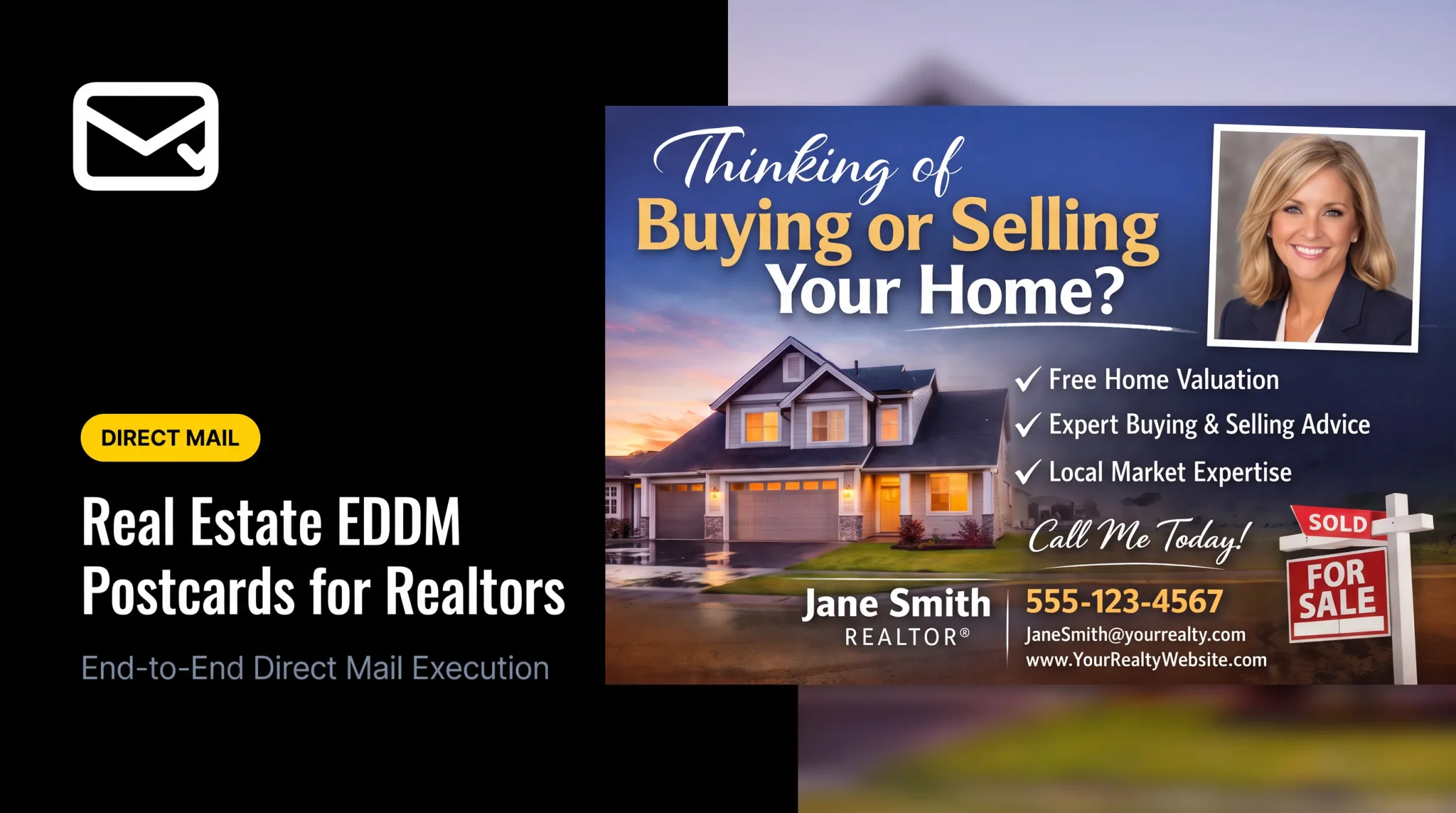
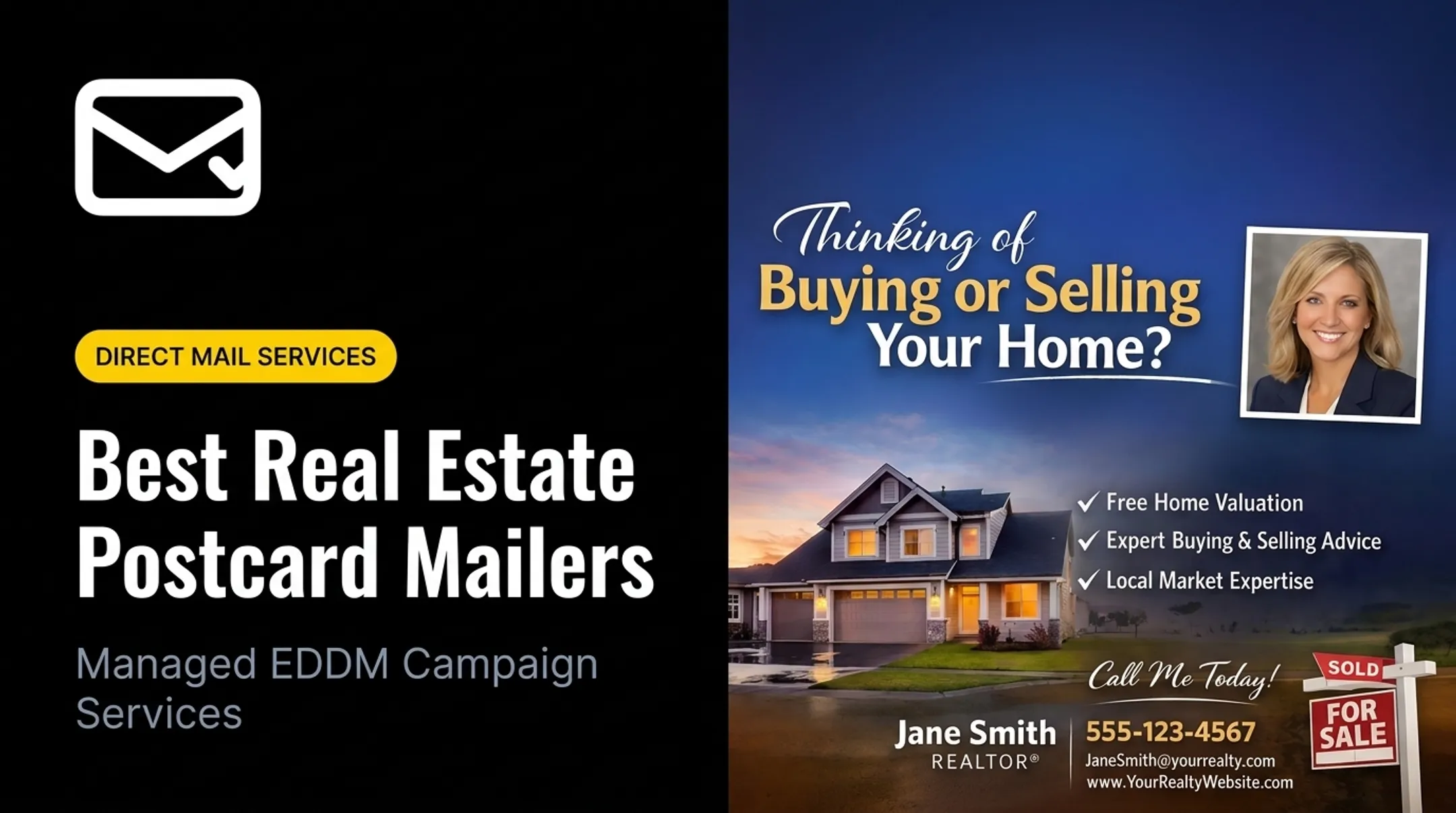
- Keep the headline short and specific ("Thinking of Buying or Selling?" beats a paragraph)
- Maintain consistent branding across every piece an agent sends
- Use high-resolution photography — property images should be at least 300 DPI for print
- Double-check listing facts, pricing, dates, and disclaimers before approval
Skip the vague "learn more" sign-off. A prominent, specific call to action, such as "Scan for your free home value," gives readers a clear next step.
Connecting Print to Digital
A QR code or short URL should lead somewhere useful: a property site, a virtual tour, a valuation form, or a scheduling page. USPS identifies QR codes, personalized URLs, and dedicated phone numbers as standard ways to bridge mail and digital response tracking.
Before the piece goes to print, test the destination:
- Does it load correctly on mobile?
- Does it match what the postcard promised?
- Is it tagged for this specific campaign, separate from other traffic?
Metrics and Common Mistakes
Different metrics matter at different stages:
- Distribution — pieces delivered or mailed
- Engagement — scans, visits, calls
- Inquiries — form fills, phone leads
- Appointments — booked consultations or valuations
- Transaction influence — leads that eventually close
Common mistakes worth avoiding:
- Cluttered layouts
- Generic copy
- Inconsistent branding
- Low-quality images
- Missing calls to action
- No follow-up plan once responses start coming in (often the costliest miss)
Brochures and postcards count as advertising. NAR guidance flags materials like brochures as subject to fair housing rules, so language and imagery need the same scrutiny as any other listing ad. Always confirm current federal, state, USPS, and brokerage requirements before a piece goes out the door.
Frequently Asked Questions
What is the best marketing for real estate agents?
There isn't one single "best" channel. Strong results usually come from consistent local branding, relationship follow-up, and targeted print campaigns tied to a clear listing or neighborhood-farming goal.
What are the best marketing materials for real estate agents?
It depends on the goal. Postcards fit just-listed, just-sold, and market updates; brochures support listing presentations; and repeated direct mail helps farm neighborhoods on a steady schedule.
How much does a print ad typically cost?
Cost depends on format, size, paper stock, finish, quantity, design work, mailing list or route selection, and postage. Request a campaign-specific quote for accurate pricing.
What are some examples of print advertising?
Common real estate examples include postcards, brochures, flyers, door hangers, just-listed or just-sold mailers, and open-house handouts.
What is printed marketing called?
It's commonly referred to as print marketing, print advertising, print collateral, or direct mail marketing when materials are sent through the mail.
What are the 4 Ps of marketing in real estate?
The four Ps are product, price, place, and promotion. The home is the product, the asking amount is price, the market area is place, and print or other outreach tactics fall under promotion.