
Introduction
"Direct to door marketing" covers a lot of ground. It can mean a USPS-delivered postcard, an unaddressed flyer tucked into a doorframe, or a rep handing out samples on a front porch.
For local businesses, the hard part is reaching a defined neighborhood efficiently while juggling targeting, creative quality, postage costs, fulfillment logistics, and response tracking. Get one piece wrong, and the whole campaign underperforms.
This article breaks down Every Door Direct Mail (EDDM), compares it against addressed mail and hand-distributed materials, and walks through how to plan a measurable campaign. Whether you're a roofer chasing storm leads or a dentist courting new patients, you'll get a practical framework for picking the right approach—and measuring whether it worked.
Key Takeaways
- EDDM hits most or all stops on selected USPS carrier routes—no mailing list needed.
- Direct-to-door also covers addressed mail, door hangers, flyers, and in-person sampling.
- Strong offers, smart routes, format, timing, and response tracking drive campaign results.
- Confirm current USPS rules first, then weigh broad coverage against list-based precision.
What Is Direct to Door Marketing?
Direct to door marketing is a group of offline tactics that put a promotional message, offer, sample, or lead-generation prompt directly into the hands of households. There is no search algorithm and no email inbox competition: just a physical piece someone can hold.
There are three main approaches, and they work differently:
- Addressed direct mail uses a customer or prospect list and supports personalization down to the name on the envelope.
- EDDM uses USPS carrier routes to blanket a neighborhood without addressing each piece to a named recipient.
- Hand-distributed materials (door hangers, flyers, samples) get physically placed at residences and don't necessarily enter the USPS mail stream at all.
Why Local Businesses Use This Format
This channel works because it ties the message to a specific place. A roofer can announce storm-response inspections to the exact ZIP codes hit by hail. A restaurant can announce a grand opening to everyone within walking distance. A political campaign can reach every registered household in a precinct.
Common examples include:
- Real estate agents farming a neighborhood with market updates
- Roofing and HVAC companies promoting seasonal tune-ups or storm inspections
- Dental practices running new-patient offers
- Insurance agents sending quote and renewal reminders
- Restaurants and retailers announcing openings or seasonal promotions
"Direct to door" does not mean a salesperson is knocking on doors. Plenty of successful campaigns are entirely print-based and rely on a well-designed postcard rather than a face-to-face pitch.
Response Mechanisms Matter
A door-delivered piece only works if the recipient knows what to do next. Effective campaigns build in a clear response path:
- QR code
- Dedicated landing page
- Offer code
- Tracked phone number
- Simple appointment form
Without one, you're guessing at results.
How Every Door Direct Mail Works
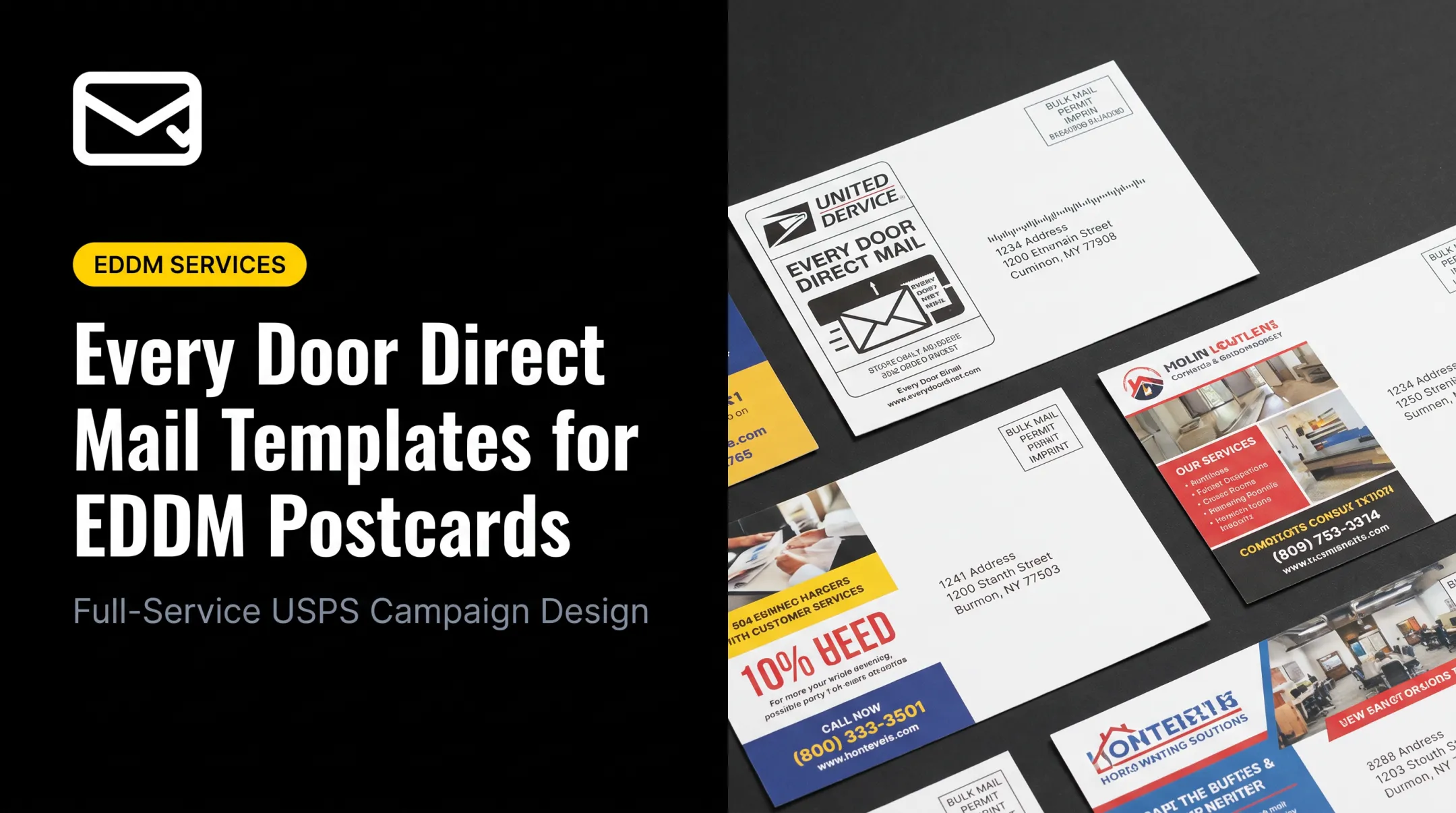
EDDM is a USPS service that lets a business select carrier routes and send eligible mail to every household on those routes, without supplying a traditional named-recipient mailing list. Pieces get addressed to "Postal Customer" rather than an individual name.
The Basic Process
- Identify your service area: the neighborhoods, ZIP codes, or trade radius that makes commercial sense for your business.
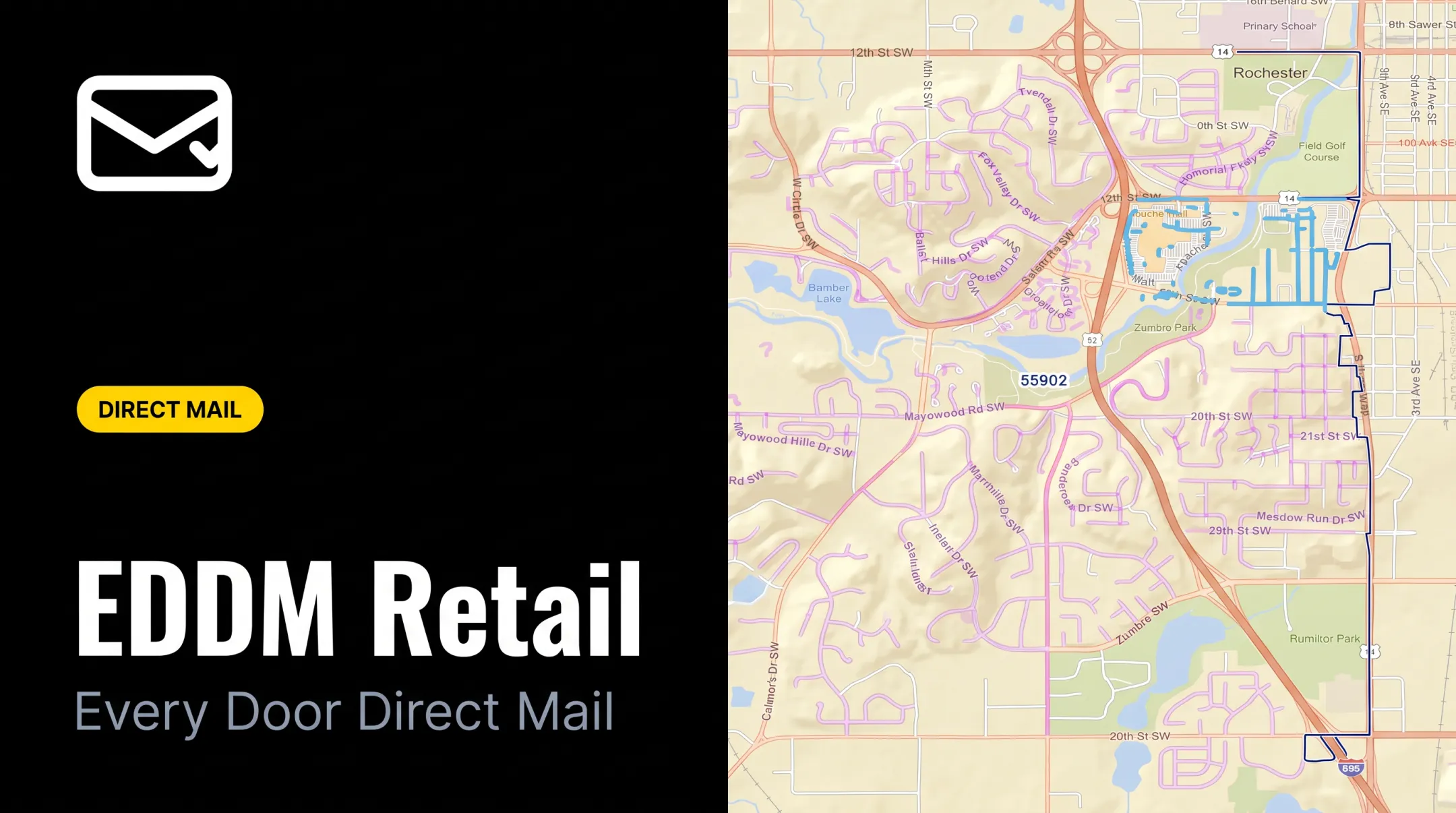
- Review available carrier routes through USPS tools, which let you search by address, city, or ZIP and see route-level demographic data.
- Choose routes based on geography and audience fit, factoring in age, income, and household density when that data supports your goal.
- Select a compliant mail piece that meets current USPS size, weight, and thickness rules.
- Prepare bundles and paperwork: pieces are separated by route, bundled, and labeled with a facing slip.
- Pay postage and submit the mailing through the appropriate USPS process for your volume.

Specifications change, so confirm current requirements before finalizing artwork. As of this writing, the USPS Quick Service Guide for EDDM-Retail sets maximum EDDM flat dimensions at 15" x 12" x 0.75", with a minimum thickness of 0.007 inches.
What EDDM Can (and Can't) Target
EDDM targets geography, not individuals. You can filter carrier routes using route-level demographic research, but you can't select a named household the way you would with a purchased list. If precision targeting of specific customers matters more than blanket coverage, EDDM isn't the tool for that job.
Advantages
- Broad neighborhood coverage without buying or managing a mailing list
- Competitive postage rates: USPS currently lists EDDM-Retail pricing around $0.26 per piece, though rates vary by entry method
- A natural fit for location-concentrated businesses: home services, healthcare, restaurants, retail, and real estate
Limitations
- Less personalization than addressed mail
- Coverage includes households outside your ideal customer profile
- Requires planning around USPS bundling, labeling, and entry timelines
- Harder to attribute results without a unique offer and response path
Is EDDM Right for You? Quick Checklist
Ask yourself:
- Is my service area dense enough that most residents could plausibly become customers?
- Do I want broad household coverage rather than a narrow list?
- Is my average customer value high enough to justify reaching some non-ideal households?
- Is my offer genuinely relevant to a whole neighborhood, not just a niche segment?
- Do I have a plan to follow up on every call, scan, or form submission?
If you answered "yes" to most of these, EDDM is worth testing.
Direct to Door Marketing vs. EDDM vs. Addressed Direct Mail
Here's how the three approaches stack up:
| Factor | EDDM | Addressed Direct Mail | Hand-Distributed Print |
|---|---|---|---|
| Delivery method | USPS carrier route | USPS, using a mailing list | Physically placed, no USPS involvement |
| Targeting | Geographic (route-level) | Named individual/household | Geographic, manual |
| Personalization | Minimal | High (name, purchase history) | None |
| List required | No | Yes | No |
| Best for | Broad neighborhood saturation | Repeat customers, known leads | Immediate, low-cost local reach |
| Operational load | USPS bundling and route paperwork | List maintenance, mail-class rules | Local permission and placement rules |
When EDDM Wins
Choose EDDM when coverage matters more than personalization:
- You want broad reach across a defined neighborhood
- You don't need named-recipient personalization
- You prefer a simple route-based USPS process
- Your customers are location-driven more than relationship-driven
When Addressed Mail Wins
Addressed direct mail fits when you already know who you want to reach:
- You have a reliable customer or prospect list
- You want personalized messaging and tighter household selection
- You're re-engaging past customers or known leads
It usually costs more per contact, but warm audiences often respond at a higher rate.
When Hand Distribution Makes Sense
Door hangers, samples, and hand-delivered flyers work well when you need:
- Hyper-local coverage in a tight trade area
- Unusual formats that don't fit standard mail specs
- Delivery outside the USPS mail stream entirely
Check local rules first. Many municipalities regulate handbill distribution, restrict placement on public property, or require permits.
DirectMailEasy supports both EDDM and targeted mailing-list campaigns, so you can pick broad route coverage or selective list targeting based on the goal of each drop.
How to Plan a Direct-to-Door or EDDM Campaign
Start with one measurable objective. Pick a single goal and build the campaign around it:
- Generating inspection requests
- Booking consultations
- Attracting new patients
- Promoting a grand opening
Define Your Geographic Audience
- Identify the service radius, trade area, or carrier routes that are realistically reachable and commercially relevant
- Layer in homeowner status, property type, income range, or age range only when the data supports your goal
- Compare the reach of route-level EDDM coverage against a more selective addressed list
Choose the Offer and Call to Action
Give recipients one specific, easy-to-understand benefit:
- A free inspection
- A first-visit discount
- An event invitation
- A limited-time promotion
Then give them exactly one next step, backed by a QR code, phone number, or booking link.
Add an expiration date only if you can honor it and follow up promptly. A vague or open-ended offer tends to get set aside.
Select Format and Creative
Match the piece to your message, budget, and USPS eligibility. Common formats include postcards, flyers, and menus. Whatever you choose, put the audience, benefit, brand, and call to action in a clear visual order. Don't make people hunt for what you're offering.
Plan Production and Fulfillment
Before printing, confirm:
- Artwork specifications and proof approval
- Print quantities and bundling requirements
- Labeling, postage, and USPS entry paperwork
- Realistic delivery timing (verify current USPS guidance rather than promising a fixed date)
This is where a full-service provider helps most. DirectMailEasy handles design, artwork refinement, commercial printing, and USPS-ready preparation in one workflow—so you are not juggling separate vendors for a single mailing. Standard turnaround runs 5-7 business days after proof approval, with rush options available when timing is tight.
Plan Follow-Up Before You Send
- Assign someone to answer calls, process forms, and book appointments
- Train staff to ask "how did you hear about us" and log the source
- Build a follow-up sequence for anyone who scans, calls, or submits a form
A campaign without a follow-up plan wastes the leads it generates.

Choosing the Right Mail Piece and Offer
Postcards work well for fast recognition and a single, clear offer. They're the format most neighborhood EDDM campaigns rely on. Larger EDDM-eligible pieces (including menus or simple folded mailers) give you more room for service details, multiple offers, or educational content.
Whichever you pick, verify current EDDM eligibility before finalizing size and format. Creative choices affect postage and handling.
Essential Creative Elements
Every piece should include:
- A prominent headline
- Recognizable business identity (logo, colors)
- A concise value proposition
- A relevant image
- A proof point or credibility marker (certifications, years in business)
- Clear offer terms
- Contact details and one primary call to action
Match the Offer to Your Industry
- Roofing and exterior contractors — storm-response consultations or free inspections
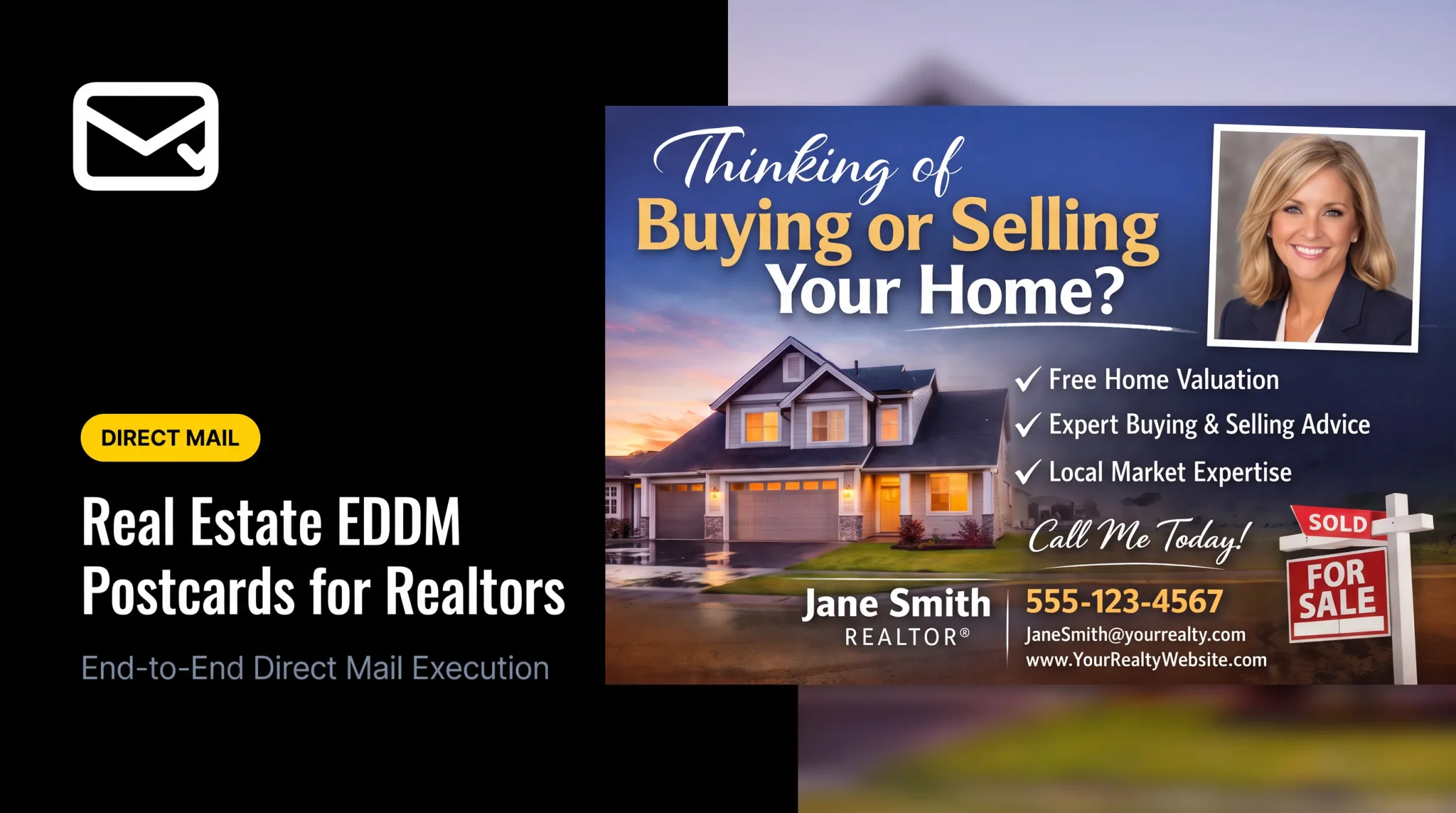
- Real estate agents — neighborhood market updates or new listing announcements
- Healthcare and dental practices — new-patient consultations or appointment requests
- Restaurants and retailers — grand openings, seasonal promotions, or neighborhood-specific offers
Avoid unsupported claims, cramped layouts, and confusing fine print. If a recipient has to squint to find your offer, you've already lost them.
Tracking Results and Improving Future Campaigns
Set a baseline budget that separates production, design, postage, route or list costs, distribution, and follow-up labor. Without that breakdown, you can't calculate real ROI.
Tracking Tools Worth Using
- Unique QR codes or dedicated landing pages
- UTM parameters for digital follow-through
- Offer or coupon codes
- Tracked phone numbers
- Appointment-form questions asking how they heard about you
- Separate URLs for different routes or creative versions
According to the ANA's 2023 Response Rate Report, 82% of respondents who track direct mail response rates use online tracking methods like QR codes and personalized URLs. That made them the most common measurement approach.
The same report found house-list direct mail delivering a 160.9% ROI versus 33.7% for prospect-list mail. Audience quality matters as much as the channel itself.

What to Monitor
- Delivered quantity
- Visits, scans, and calls
- Form submissions and booked appointments
- Redeemed offers
- Qualified leads and new customers
- Revenue and return on marketing investment
Test one variable at a time when possible: headline, offer, format, route selection, or follow-up process. A single drop rarely provides enough evidence for a final decision. Compare results across multiple campaigns while accounting for seasonality, offer strength, and delivery timing.
Frequently Asked Questions
Are EDDM postcards worth it?
EDDM postcards tend to pay off when your audience is geographically concentrated, your offer is relevant, and your customer value is high enough to absorb some non-ideal households. Results still depend on route selection, creative quality, and follow-up.
What is direct to door marketing?
Direct-to-door marketing is physical outreach delivered to residences—including EDDM, addressed direct mail, door hangers, flyers, samples, and other neighborhood distribution methods. The common thread is a physical piece reaching a household directly.
What products are commonly sold door-to-door?
Door-to-door outreach commonly promotes home services, telecommunications, energy plans, security systems, subscriptions, retail products, and local offers. Note that direct-to-door marketing materials don't always involve in-person selling; many are entirely print-based.
What are the four main types of direct marketing?
The four types most often cited are direct mail, email marketing, telemarketing, and digital or mobile direct response. EDDM sits inside the direct-mail category—it is a delivery method, not a separate type on its own.