
Digital marketing has its place, but it's easy to ignore. A mailer sitting on the kitchen counter is harder to skip. The real challenge isn't just showing up in someone's mailbox. It's creating an offer that's memorable, reaches a realistic trade area, drives one clear action, and can actually be measured against visits or revenue.
This guide walks through audience selection, EDDM versus targeted mailing lists, mailer design, restaurant campaign ideas, cost factors, and how to track results.
Key Takeaways
- Reach nearby diners with offers, menu launches, event invites, and loyalty messages
- Pair one offer, one call to action, plus clear address, hours, and ordering details
- Use EDDM for broad neighborhood coverage without a list; use targeted lists for precision
- Track response with unique codes, QR codes, and dedicated landing pages
Why Direct Mail Marketing Can Work for Restaurants
A postcard doesn't vanish the moment someone scrolls past it, the way a social media ad does. It sits on a counter or gets stuck to a fridge, where it can stay visible for days. That kind of lingering presence matters when you're trying to reach households within a few miles of your dining room.
Direct mail fits a range of restaurant goals:
- Bringing in first-time guests near a new or existing location
- Reactivating lapsed customers who haven't ordered in months
- Boosting takeout and delivery volume during off-peak hours
- Filling slow weeknights with a targeted offer
- Promoting catering or private events to nearby offices and households
There's evidence this works. A 2022 Restaurant Dive article sponsored by Vericast reports that 53% of consumers say direct mail influences them to visit a restaurant or order delivery/carryout (Vericast Awareness-to-Action Study, March 2022), and 39% are more likely to make a repeat purchase if offered a deal (Vericast Deals & Coupons Report). It's a sponsored piece without a published sample size, so use it as directional support—not a promised response rate.
The same source reports that 74% of millennials and 72% of Gen Z will go online after seeing a print ad, for example to view a menu, download an app or place an order. That's the practical upside: direct mail doesn't have to compete with digital. It can send people there. A QR code on a postcard can land someone on your ordering page in seconds.

Response only pays off inside a realistic trade area. A generous $10-off offer looks great until you mail it three towns over, where nobody's driving 25 minutes for a burger. Match offer cost and mailing radius to what your kitchen can absorb and what a nearby household will actually act on.
Acquisition and retention campaigns also need different messages:
- New guests: bigger incentive, simple call to action
- Lapsed guests: "we miss you" tone plus one clear reason to return
- Regulars: thank-you reward, not a hard sell
How to Plan and Target a Restaurant Direct Mail Campaign
Before any design work starts, write a short campaign brief. Nail down:
- Objective – new customers, reactivation, or a specific revenue stream
- Target customer and service area – who you're reaching and how far
- Offer and mailing window – what you're promoting and when it drops
- Primary CTA and redemption method – order online, call, or bring the mailer in
- Success metric – redemptions, calls, orders, or visits
EDDM: Broad Neighborhood Coverage
Every Door Direct Mail (EDDM) reaches every home along selected USPS carrier routes without requiring a restaurant-owned mailing list. It's a solid fit for grand openings, seasonal pushes, or general neighborhood awareness where you don't need to filter by household type.
A few things to know about EDDM:
- Requires a 200-piece minimum per mailing
- DirectMailEasy's EDDM printing starts at $0.19 per piece, and EDDM postage runs between 24 and 30 cents per piece depending on destination
- USPS's own EDDM page currently lists EDDM Retail flats at $0.26 per piece as a benchmark
- Routes can be selected by ZIP code or drawn directly on a map
Targeted Mailing Lists: More Precision
Targeted lists work better when you want to filter by ZIP code, radius, carrier route, income, homeowner status, or age. Available filters and privacy practices vary by provider, so confirm exactly what's included before you commit.
| Factor | EDDM | Targeted List |
|---|---|---|
| Audience control | Route-based, broad | Filtered by demographics/geography |
| Personalization | Limited | Higher |
| Setup complexity | Lower | Moderate to higher |
| Best use case | Openings, neighborhood awareness | Reactivation, specific household types |
Segment your audience around realistic restaurant patterns:
- Nearby families
- Office workers within lunch-delivery range
- New residents
- Existing customers and lapsed guests
- Households inside your delivery radius
Timing matters as much as targeting. Line up mailings with grand openings, seasonal menu changes, holidays, school calendars, or slow weekdays.
Then work backward from your drop date. At DirectMailEasy, most orders ship within 5-7 business days after proof approval, and UV coatings require an additional 5 days. Build in a buffer for USPS processing and delivery variation.

EDDM planning checklist:
- Confirm carrier routes and check for overlap with prior mailings
- Verify delivery boundaries against your actual trade area
- Double-check current USPS size and preparation requirements
- Set offer expiration dates around your mailing window, not your kitchen's prep schedule
What to Put on a Restaurant Direct Mailer
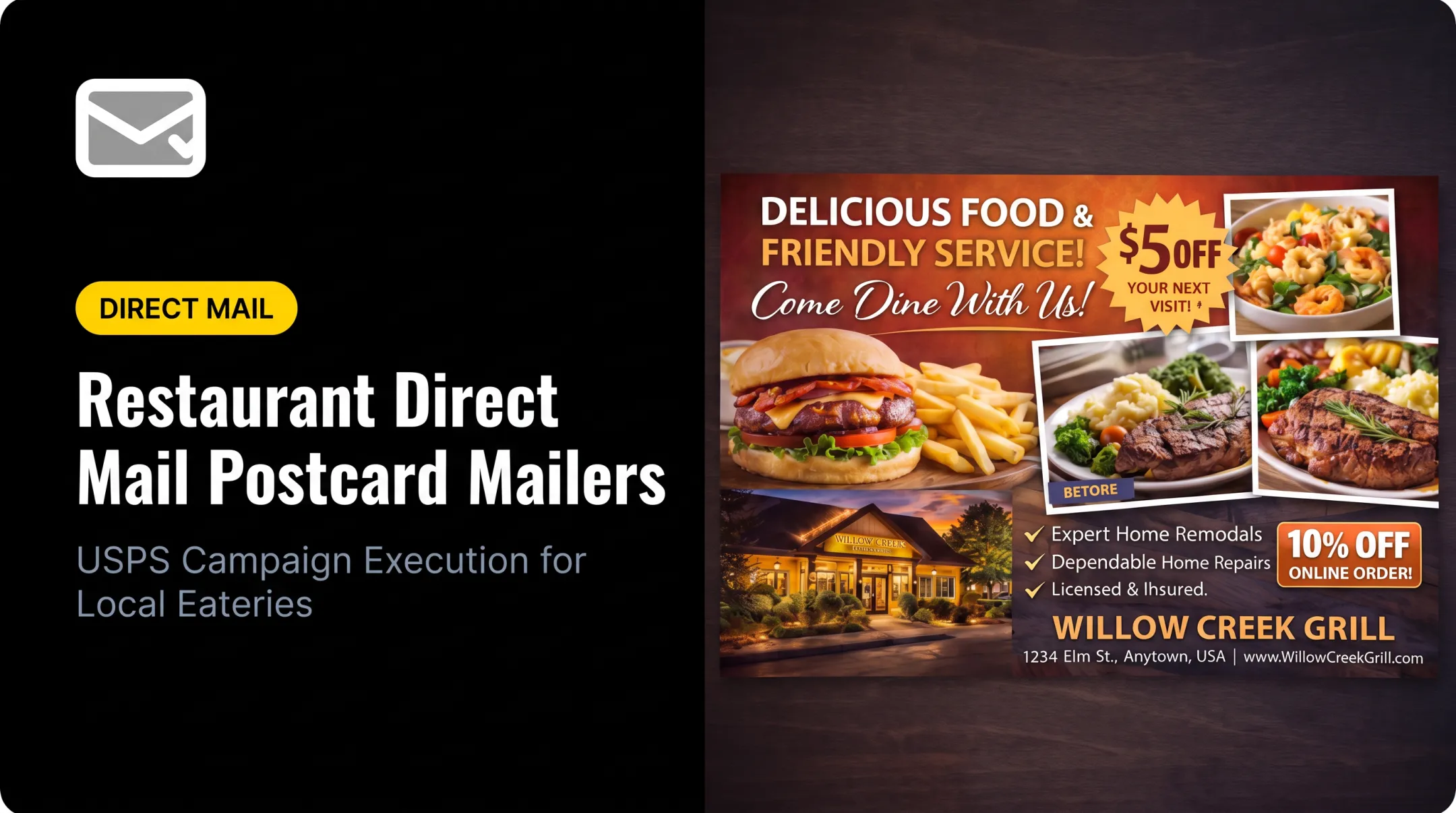
Readers skim mail quickly before deciding to keep it or toss it. Give them a clear hierarchy: headline, restaurant name and location, one featured offer, one strong food image, essential details, and a single call to action.
Build an Offer That's Actually Profitable
A good restaurant offer accounts for food cost, redemption conditions, and average order value, not just what sounds generous on paper. Common formats include:
- A new-customer discount or free add-on
- A limited-time menu item promotion
- A family meal bundle
- A weekday-only special
- A free catering consultation
For example, a 5x7 postcard might lead with $5 off a first dine-in visit and one hero burger shot, not a full menu. One offer, one visual story, and the rest of the piece supports the redeem path.
Cover the Practical Details
Every mailer needs:
- Restaurant name and address or service area
- Phone number and website/ordering URL
- Hours, where relevant
- Reservation or delivery instructions
- Expiration date and any restrictions
- A scannable QR code, if used
Keep the Call to Action Singular
Competing instructions confuse readers. Pick one: "Order online," "Reserve your table," "Visit this week," or "Bring this offer to redeem." Design around that one action: large type, strong contrast, and white space so the offer stays obvious on both sides.
Match format to the job:
- 5x7 postcard: Quick offers, weekday specials, and repeat drops
- 6x11 postcard: Grand openings, events, and bigger food visuals
- Longer offers: Feature one bundle or catering package—don't cram a full menu onto the card
Restaurant Direct Mail Ideas and Examples
Different goals call for different mailers. Match the piece to the outcome you want:
Customer acquisition:
- Grand-opening announcements
- New-location reveals
- New-mover welcome offers
- Neighborhood introduction promotions
- First-order delivery or takeout incentives
Retention and reactivation:
- Seasonal limited-time offers
- Birthday or anniversary messages
- Lapsed-customer win-back mailers
- Loyalty-program invitations
- Thank-you pieces after a big order or event
Revenue-specific campaigns:
- Weekday traffic promotions
- Family meal bundles
- Catering package mailers
- Private-event invitations
- Holiday preorder reminders
Creative should follow the same logic. A coffee shop grand opening might use latte and pastry photography with a $1-off drink on a 6x11 announcement piece. A fine-dining spot promoting a private-event space needs a more restrained design—less discounting, more atmosphere.
A food truck chasing weekday lunch traffic will run a different offer than a bar pushing Thursday happy hour. Segment the creative when you can: lunch versus dinner audiences, or dine-in guests versus delivery-only households.
A Hypothetical Example
Say a casual Italian restaurant wants to boost weeknight dinner traffic. One workable setup:
- Format: EDDM across five carrier routes within a two-mile radius
- Offer: Family meal bundle, valid Monday through Thursday
- CTA: QR code to online ordering
- Measurement: QR scans and redemptions over four weeks
That mix keeps the goal, audience, offer, and tracking method on one card.
How to Launch, Track, and Improve the Campaign
Once the offer and creative are locked, the workflow moves through production and the mail stream. Build in time for corrections and uneven delivery windows.
Typical launch sequence:
- Proof approval
- Printing
- Addressing or EDDM route prep
- USPS processing
- Delivery to households
A full-service partner like DirectMailEasy collapses designer, printer, list/route setup, and USPS paperwork into one path: choose the product, approve the design, then print and mail.
Planning for Cost
Budget across these components separately:
- Design and artwork
- Printing (EDDM print starts around $0.19 per piece)
- Postage (roughly 24-30 cents per piece for EDDM, depending on destination)
- List or route targeting
- Finishing (coatings, folds)
- Fulfillment and USPS processing
Get a quote based on your full campaign spec rather than estimating from a single line item.
Tracking What Matters
Connect the physical mailer to a measurable action using:
- Unique promo codes
- Dedicated landing pages
- QR codes
- Reservation keywords
- POS redemption fields
- Call-tracking numbers
Each method has limits. QR scans and code redemptions only capture identifiable actions, not every walk-in influenced by the mailer.
Record performance across:
- Delivery timing
- Scans, calls, and reservations
- Orders and redemption counts
- New versus returning guests
- Average order value and profit after campaign costs
Test one variable at a time when you can—offer, headline, or audience.
The ANA's Response Rate Report found a 15.6% response rate for house lists versus 10.8% for prospect lists. The report is based on self-reported survey data and the prospect-list figures come from a small base, so treat them as directional—not a restaurant benchmark. Compare your own mailed versus unmailed areas for a real read on performance.

When you are ready for the next drop, DirectMailEasy can help lock audience, offer, and format, then run design, print, targeting, and mailing from one place.
Frequently Asked Questions
How much does a direct mailer cost?
Cost depends on design, format, quantity, printing, postage, and whether you use EDDM or a targeted list. Request a quote based on your full campaign details for an accurate number.
What is the best marketing strategy for restaurants?
The best strategy pairs a clearly defined local audience with a profitable offer, a consistent brand message, and one strong call to action. Measure results across both direct mail and digital channels.
What are some examples of direct mail marketing?
Common examples include grand-opening announcements, coupons, seasonal promotions, new-menu mailers, event invitations, loyalty campaigns, catering offers, and lapsed-customer win-back pieces.
What are common mistakes when using EDDM?
Frequent mistakes include picking routes outside a realistic trade area, running an unclear offer, skipping redemption details, leaving too little lead time before mailing, and not verifying current USPS requirements.
How can restaurants track direct mail results?
Use unique promo codes, QR codes, dedicated landing pages, trackable ordering links, reservation keywords, and POS redemption fields. Then compare mailed areas or periods against unmailed ones.
Should a restaurant use EDDM or a targeted mailing list?
EDDM suits broad neighborhood coverage when you don't have a customer list. Targeted lists work better when you need more control over geography or household characteristics.