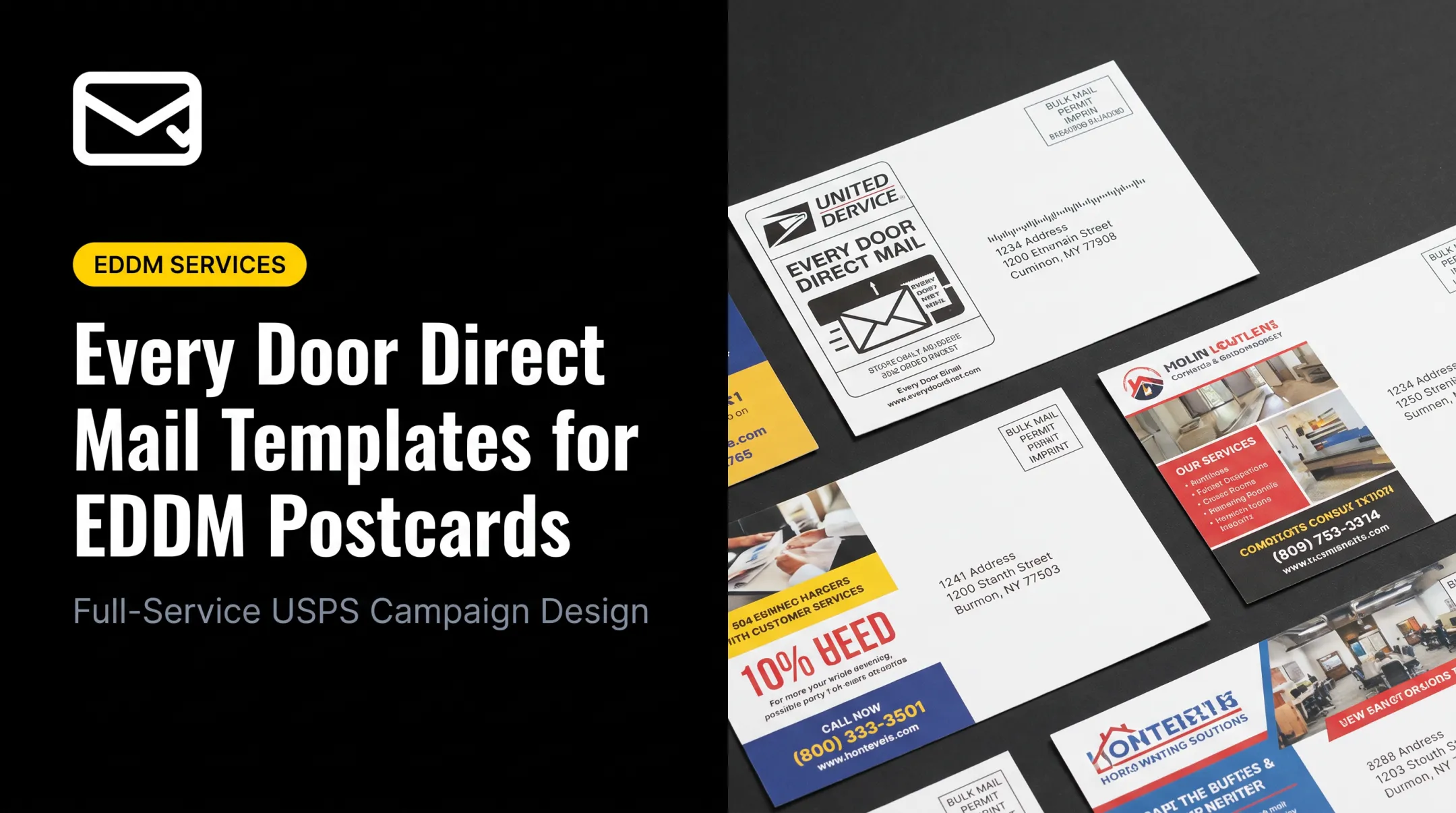

Every Door Direct Mail (EDDM) is one answer. It's a USPS mailing service that delivers postcards to every address on a selected carrier route, generally without requiring you to supply a mailing list at all. You pick the neighborhood; USPS handles the rest of the delivery logistics.
This guide covers where EDDM fits into a realtor's marketing plan, how to design a postcard that actually gets read, USPS rules you can't skip, mistakes that waste a mailing, and how to tell if a campaign worked.
Key Takeaways
- EDDM reaches entire carrier routes without a mailing list, ideal for low-lift neighborhood farming.
- Route selection matters more than route size: pick areas tied to your listings, past sales, or farm strategy.
- One clear headline and one call to action outperform a crowded, credential-heavy design.
- USPS has strict size, bundling, and indicia rules that must be verified before printing.
- Track a unique phone number, QR code, or landing page so results aren't guesswork.
Why Real Estate EDDM Postcards Can Work for Realtors
Neighborhood farming works on repetition. Homeowners need to see your name several times before they associate it with "the agent on my street." EDDM supports that by putting your branding, listings, and local expertise in front of every household on a route, not just the ones on a purchased list.
EDDM vs. Targeted Direct Mail
EDDM and targeted mailing lists solve different problems:
- EDDM covers a full carrier route using simplified addressing (no names required), which is why USPS classifies it as saturation mail.
- Targeted mail uses a list filtered by homeowner status, income, age, or radius, letting you personalize the message to a narrower audience.

Neither is universally better. EDDM wins on coverage and simplicity. Targeted lists win on precision.
Where EDDM Fits Best
EDDM tends to work well for:
- Launching a new farm area where you have no existing list
- Promoting an open house to the surrounding blocks
- Announcing a just-sold result to nearby homeowners
- Introducing a new agent or team to a neighborhood
- Distributing a local market update to build recurring visibility
Main advantages:
- Reach an entire route without maintaining a list
- Postage that's often lower than individually addressed mail formats (verify current USPS rates before budgeting)
- Repeated visibility over time, rather than a single one-off announcement
- A physical mailpiece that drives recipients to a digital action, such as a home valuation form or market report
When Targeted Lists Make More Sense
EDDM isn't the right tool for every situation. Skip it when you need:
- Recipient names for personalized messaging
- Specific homeowner qualification, such as confirmed homeowners in a particular income or age range
- Confidential prospecting that shouldn't blanket an entire street
- One-to-one follow-up tied to a known contact
In those cases, a targeted mailing list filtered by ZIP, radius, or homeowner status is the better fit. Match the channel to the farm goal—then keep drops consistent so your name sticks on the street. DirectMailEasy can handle design, print, and USPS mailing so the schedule stays on track without extra admin.
How to Plan and Design a Realtor EDDM Postcard Campaign
Before touching a design template, decide on one objective and one primary action you want recipients to take. Attending an open house, requesting a valuation, scanning a QR code for a market report, or calling about a listing are all valid goals, but trying to accomplish all of them on one card usually accomplishes none.

Choosing Routes Strategically
Don't just pick the biggest available area. Consider:
- Proximity to your active listing or recent sale
- Neighborhood ownership patterns and turnover
- Recent housing activity nearby
- Your realistic capacity to follow up locally
The USPS EDDM route-selection tool shows residential, business, and total delivery points for each route, plus Census-based data such as age range, average household size, and average household income. Use those fields to confirm the route matches your goal—not just the highest piece count.
Building the Message Hierarchy
A well-designed postcard follows a simple order:
- Headline — communicate the news or benefit in one glance ("Just Listed on Maple Street" beats "Jane Smith, Realtor").
- Visual proof — one strong property photo, agent photo, or local insight. Don't stack all three.
- Value to the recipient — what's in it for them, not just your credentials.
- Call to action — repeat your phone number, website, or QR code so it's impossible to miss.
Every card should also include your brokerage branding, contact details, any required license disclosures, listing specifics when relevant, and one clear next step.
Design and Preflight Checklist
For fast scanning, prioritize high-resolution photography, readable type, strong contrast, and consistent brand colors. Before sending anything to print, confirm:
- Images are print-resolution, not web-resolution
- Spelling and phone numbers are correct
- URLs and QR codes actually work when tested
- Compliance language and offer dates are current
- A final proof is approved before print
Real Estate EDDM Postcard Ideas for Different Campaign Goals
The same core message doesn't perform identically across every neighborhood, but these formats give you a reliable starting point.
- Just listed: Lead with the property's strongest selling points, pricing or positioning where it helps, and a simple showing or open-house CTA with a path to more photos.
- Just sold: Prove local results with a recent transaction, note the buyer or seller type you helped, and invite nearby owners to request a valuation—without overstating the outcome.
- Open house / coming soon: Put date, time, and address (or area) up front, plus a clear backup action for anyone who can't attend that day.
- Market update / seller education: Share one useful local insight (median days on market, recent sale prices) and point readers to a fuller report or a conversation.
- Agent intro, seasonal, community value: A short introduction, seasonal home tip, or neighborhood-relevant note gives people a reason to keep the card.
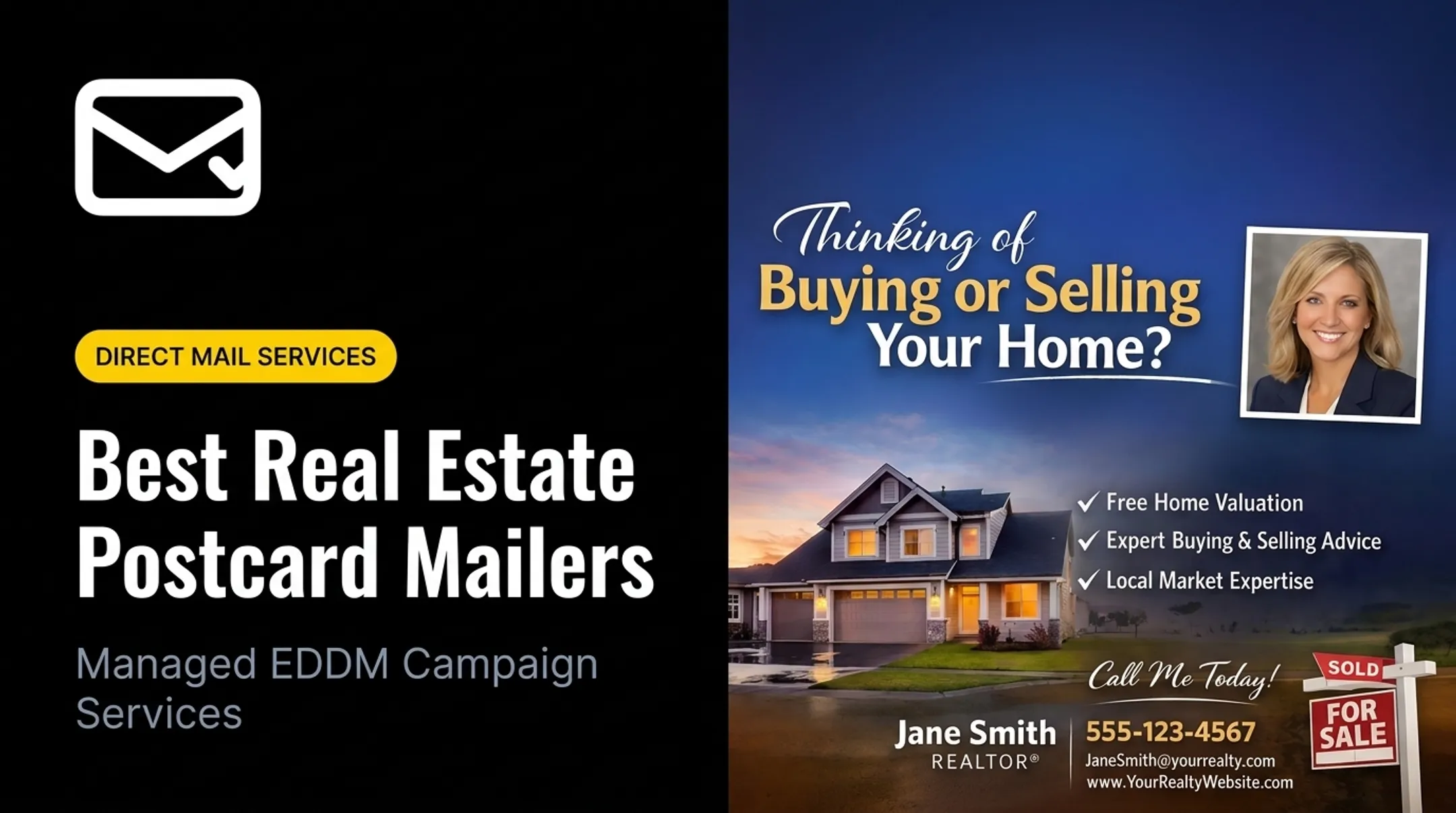
A 6x9 card built around a headline like "Thinking of Buying or Selling Your Home?", a friendly agent photo, and a free home valuation offer is a common structure for introduction mailings. Match the offer and image to the neighborhood: a luxury coastal street and a starter-home suburb rarely respond to the same message.
USPS Requirements, Common Mistakes, and Campaign Execution
EDDM postcards must meet current USPS specifications for size, thickness, weight, labeling, and route documentation. Always verify exact figures against current USPS guidance before printing, since postage and limits change periodically.
| Requirement | General Rule |
|---|---|
| Mail class | USPS Marketing Mail saturation flats with simplified addressing |
| Minimum quantity | 200 pieces or 50 pounds per mailing |
| Daily maximum | 5,000 pieces per day per 5-digit ZIP Code |
| Size | Must fall within EDDM flat-size limits (verify current dimensions) |
| Bundling | 50-100 pieces per bundle, with a facing slip |
| Indicia | Placed in the upper-right corner per USPS formatting rules |
According to USPS's Every Door Direct Mail program, EDDM pieces are delivered to every address on a selected route using simplified addressing rather than individual names. The USPS EDDM User Guide confirms the 200-piece minimum and the 5,000-piece daily cap per ZIP Code, both of which shape how large or small a single drop can realistically be. USPS Quick Service Guide 140 sets out the 50-100-piece bundle rule and the facing-slip requirement.
Common Mistakes to Avoid
- Choosing routes based purely on volume instead of relevance to your farm area
- Sending a generic card with no clear offer or local context
- Cramming too much copy on the card, burying the contact information
- Skipping tests on QR codes, landing pages, and phone numbers before the drop
- Judging results from one drop instead of testing message, route, and timing across campaigns
DIY vs. Managed Service
DIY EDDM means you own design, printing, USPS forms, bundling, and drop-off. You keep full control, but those steps compete with showings and closings.
A managed provider takes on that admin work and lowers the chance of formatting or processing errors. DirectMailEasy handles design refinement, commercial printing, route selection, and USPS paperwork and indicia in one workflow, and most orders ship within 5-7 business days after proof approval. Confirm timing for your quantity, and compare the full quote, turnaround, and proofing before you commit either way.
Consistency matters more than any single drop. A 2024 Taradel case study on Templeton Real Estate Group's Boise-area campaigns reports more than 2 million EDDM postcards across 130-plus campaigns since 2013, with sustained local visibility and lead flow rather than one spike.

Measuring Results
Once the mail is out, track it with a unique QR code, dedicated landing page, or campaign-specific phone number. Record:
- Routes mailed and quantities sent
- Drop dates
- Responses, appointments, and qualified leads
- Transactions tied back to the campaign
Compare those results to total campaign cost. Separate quick responses from the brand recognition that builds across repeat mailings. A landing page, email follow-up, or social post extends the postcard's value past the drop date.
Frequently Asked Questions
How much does an EDDM postcard cost?
Cost depends on size, stock, quantity, design, printing, and postage. USPS requires at least 200 pieces per EDDM mailing. Ask for a clear, itemized quote with printing, postage, design and list costs explained, and request a current quote, since postage rates change periodically.
What are the requirements for EDDM postcards?
Current USPS rules cover size, weight, thickness, bundling (50-100 pieces per bundle), indicia placement, and route documentation. Always verify these specifications against current USPS guidance before sending anything to print.
What are the best postcards for realtors?
Match the card to your goal—just listed, just sold, open house, market update, agent introduction, or community value. Stick to one clear message, strong visuals, and a single measurable call to action.
What are common mistakes when using EDDM?
Watch for these frequent errors:
- Choosing routes by volume instead of farm-area relevance
- Mailing generic copy with no clear offer
- Cluttering the layout or skipping CTA tests before the drop
- Judging performance from one mailing instead of several campaigns